
Eating cheese can be part of a healthy diet: it supplies protein, calcium and vitamin B12. However, most cheeses are also high in saturated fat and sodium. The type you choose and the portion you eat matter far more than whether you eat cheese at all.
Quick answer: Eating cheese in typical portions, about 1 oz (28 g), suits most people. Prospective studies link moderate intake, around 40 g a day, with a slightly lower risk of heart disease, but that evidence is observational. The real watch-outs are sodium (feta, parmesan and American cheese are highest), saturated fat, and listeria in some soft cheeses for people who are pregnant, older adults and anyone with a weakened immune system.
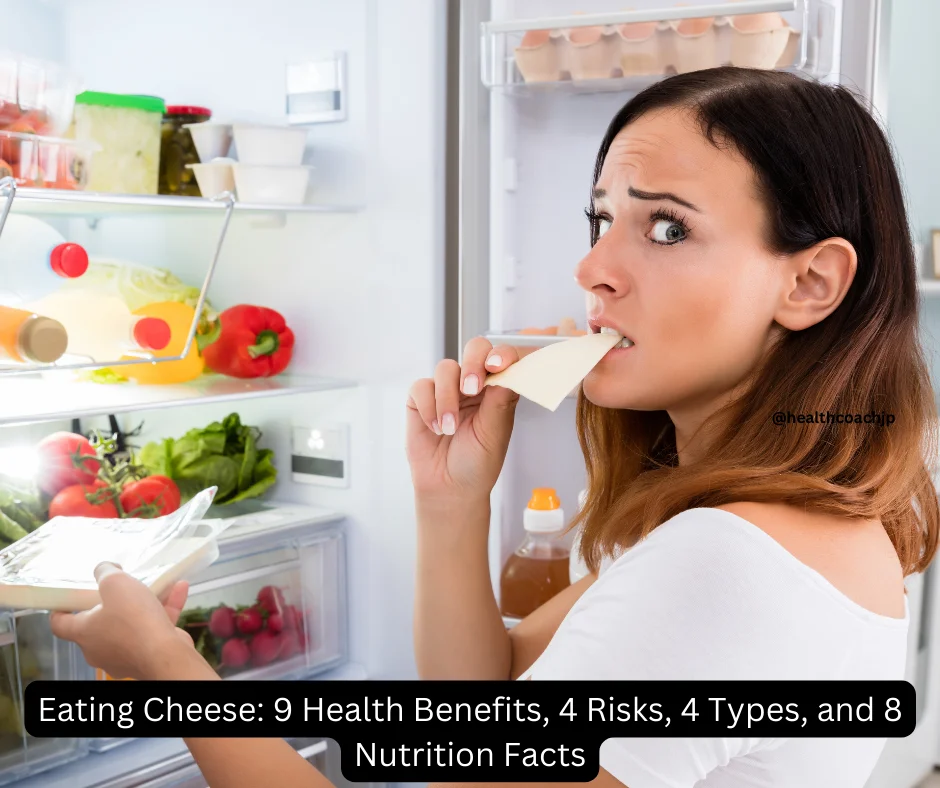
Cheese is made by curdling milk, usually from cows, goats, sheep or buffalo. Bacterial cultures, acid or rennet make the milk protein casein clump into curds. The curds are drained, salted and then either eaten fresh or aged. Those steps decide almost everything on the nutrition label, from water content to salt.
Eating Cheese: Nutrition Facts by Type
The table below puts ten common cheeses on one basis: 1 oz (28 g), the portion most US labels use. All figures come from USDA FoodData Central reference data. For a deeper look at single cheeses, see our guides to mozzarella cheese nutrition, cottage cheese nutrition and American cheese nutrition by brand.
| Cheese (1 oz / 28 g) | Calories | Protein | Fat | Sat fat (%DV) | Calcium (%DV) | Sodium (%DV) |
|---|---|---|---|---|---|---|
| Cheddar | 113 | 6.4 g | 9.3 g | 5.3 g (26%) | 199 mg (15%) | 183 mg (8%) |
| Mozzarella, whole milk (fresh-style) | 84 | 6.2 g | 6.2 g | 3.9 g (19%) | 141 mg (11%) | 136 mg (6%) |
| Mozzarella, low-moisture part-skim | 83 | 6.7 g | 5.5 g | 3.2 g (16%) | 195 mg (15%) | 186 mg (8%) |
| Brie | 94 | 5.8 g | 7.8 g | 4.9 g (24%) | 52 mg (4%) | 176 mg (8%) |
| Gouda* | 100 | 7.0 g | 7.7 g | 4.9 g (25%) | about 196 mg (15%) | about 230 mg (10%) |
| Feta | 74 | 4.0 g | 6.0 g | 3.7 g (19%) | 138 mg (11%) | 319 mg (14%) |
| Swiss | 110 | 7.6 g | 8.7 g | 5.1 g (25%) | 249 mg (19%) | 52 mg (2%) |
| Parmesan (hard) | 110 | 10.0 g | 7.0 g | 4.1 g (21%) | 332 mg (26%) | 329 mg (14%) |
| American (pasteurized process) | 102 | 5.1 g | 8.6 g | 5.1 g (25%) | 293 mg (23%) | 468 mg (20%) |
| Cottage cheese, 4% (creamed) | 27 | 3.1 g | 1.2 g | 0.5 g (2%) | 23 mg (2%) | 88 mg (4%) |
Two patterns stand out. First, calcium varies about six-fold, from 52 mg in brie to 332 mg in parmesan. Second, sodium varies about nine-fold, from 52 mg in Swiss to 468 mg in American cheese. So “cheese is rich in calcium” and “cheese is salty” are both only partly true. To compare packs yourself, our guide on how to read nutrition labels walks through %DV step by step.
Why Cheese Nutrition Figures Disagree
Search “calories in cheese” and you will see numbers that differ by 20% or more for the same cheese. There are four main reasons.
- Water content. Fresh-style whole-milk mozzarella is about half water in USDA data, while parmesan is far drier. As a result, the same weight of parmesan carries more protein, calcium and salt.
- Serving basis. Some sites quote 1 oz, some quote one slice, and some quote 100 g. A slice of American cheese is not always 28 g, so per-slice and per-ounce figures rarely match.
- Old Daily Values. Before the 2016 label update, the sodium DV was 2,400 mg. Many older pages still use it, which makes cheese look slightly lower in sodium than today’s 2,300 mg basis shows.
- Whey loss. Much of milk’s calcium can leave with the whey during cheesemaking, and soft-ripened cheeses retain less. That is why brie has a quarter of the calcium of cheddar, even though both are full-fat.
In practice, read the label on the cheese you actually buy. Reference data shows the typical range. Your brand may sit anywhere inside it.
Health Benefits of Eating Cheese: What the Evidence Shows

1. Protein, and a small muscle signal in older adults
An ounce of parmesan gives about 10 g of protein, and cheddar about 6 g. In one 12-week trial, 100 healthy adults over 60 added 210 g of ricotta a day, about 18 g of protein. Muscle mass rose slightly in the ricotta group and fell in the control group. However, the gain in grip strength did not reach statistical significance, and the trial was small. Treat it as promising, not proof. For other protein options, see our list of vegetarian protein-rich foods.
2. Calcium for bones, depending on the cheese
Hard cheeses are among the densest calcium foods. One ounce of parmesan covers about a quarter of the daily value. By contrast, brie and cottage cheese supply very little. If you rely on dairy for calcium, compare cheese with whole milk nutrition facts and yogurt rather than assuming every cheese counts equally.
3. Heart health: a neutral-to-modest association
A 2017 meta-analysis of 15 prospective studies, covering about 200,000 people, found that higher cheese intake was linked to a 10 to 14% lower risk of cardiovascular disease. The lowest risk appeared at roughly 40 g a day. Still, these are observational studies, so they show association rather than cause. People who eat moderate cheese may differ in many other ways.
Meanwhile, saturated fat and sodium still count. If your doctor is managing your LDL cholesterol or blood pressure, cheese is a portion question, not a free pass. Our guides to cholesterol-lowering foods and how to lower blood pressure naturally cover the bigger picture. A Mediterranean diet meal plan is one well-studied pattern that includes modest amounts of cheese.
4. Teeth: a supporting habit, not a treatment
Small studies have measured how cheese affects the acidity of dental plaque after eating. They suggest cheese can help neutralise acid. That is useful, but it does not replace brushing, fluoride or dental check-ups.
5. Lower lactose in aged cheese
According to the NIDDK, hard cheeses such as cheddar and Swiss are lower in lactose than other milk products. In addition, many people with lactose intolerance can handle about 12 g of lactose, the amount in a cup of milk, with mild or no symptoms. As a result, eating cheese is often easier than drinking milk for people with lactose intolerance.
Cheese Claims: Where the Evidence Stands
Cheese attracts big claims online. Here is how the common ones hold up.
| Claim | Where it stands |
|---|---|
| Moderate cheese intake is linked to lower heart disease risk | Supported as an association. Observational data only, with the best result near 40 g a day. |
| Cheese builds muscle | Overstated. One small 12-week trial in older adults found a slight muscle-mass benefit from 210 g of ricotta daily. |
| All cheese is rich in calcium | Overstated. Parmesan has about six times the calcium of brie per ounce. |
| Cheese protects your teeth | Overstated. It may reduce plaque acidity after meals, but it is not a substitute for dental care. |
| Cheese prevents type 2 diabetes | Not supported. No single food prevents diabetes, and trial evidence is lacking. |
| Cheese lowers blood pressure | Not supported. Many cheeses are high in sodium, which works in the opposite direction. |
| Cheese blocks cholesterol and calorie absorption | Not supported. Cheese supplies both fat and calories in full. |
| Cheese is a good source of omega-3 | Not supported. Oily fish and some seeds are far richer sources. |
| The CLA in cheese helps weight loss | Not supported at the small amounts found in food. |
| Cheese works as a probiotic | Not established. Few cheeses are tested or labelled for live probiotic strains. |
Eating Cheese Safely: Listeria, Pregnancy, Sodium and Medicines

Listeria and pregnancy: US and UK advice differ
Listeria is the main food safety concern with cheese. CDC data show people who are pregnant are about 10 times more likely to get listeriosis than the general population, and adults 65 and older about 4 times more likely. The NHS warns that listeriosis can cause miscarriage or stillbirth, or make a newborn very unwell. According to the CDC, soft, high-moisture cheeses are more likely to be contaminated than hard cheeses.
The US and UK draw the lines differently. The biggest recent change is in the US: in 2025 the FDA advised higher-risk people to avoid all queso fresco-type cheeses, even pasteurized ones, unless heated. That is because cheese made with pasteurized milk can be recontaminated in an unsanitary plant.
| Cheese type | US (FDA / CDC), higher-risk groups | UK (NHS), pregnancy |
|---|---|---|
| Hard cheese (cheddar, parmesan, gruyere) | Lower risk than soft cheese. Choose pasteurized where possible. | Safe, even if unpasteurised. |
| Pasteurised soft cheese (mozzarella, cottage cheese, feta, halloumi) | Choose pasteurized. Buy sealed, refrigerated, in-date packs. | Safe. |
| Queso fresco-type (queso fresco, queso blanco, panela) | Avoid all, pasteurized or not, unless heated to 165F (74C) or steaming hot. | Follow the soft cheese rules: pasteurised and fully cooked is the safe choice. |
| White-rind mould-ripened (brie, camembert, chevre) | Choose pasteurized. Cooking to steaming hot removes the risk. | Avoid unless cooked until steaming hot, pasteurised or not. |
| Soft blue cheese (gorgonzola, roquefort, Danish blue) | Choose pasteurized. Cooking to steaming hot removes the risk. | Avoid unless cooked until steaming hot, pasteurised or not. |
| Raw-milk cheese | FDA advises higher-risk people to avoid. CDC advises everyone to choose pasteurized dairy. | Hard cheese is safe; soft unpasteurised cheese only if thoroughly cooked. |
Whichever country you are in, a few habits help. Keep cheese at or below 40F (4C), discard soft cheese left out for more than 2 hours, and wash your hands after handling queso fresco-type cheese. If you feel unwell after eating a higher-risk cheese while pregnant, contact your midwife, doctor or, in the UK, NHS 111.
Sodium: the biggest everyday issue
US labels base %DV on 2,300 mg of sodium a day. In the UK, adults are advised to eat no more than 6 g of salt a day, which equals about 2.4 g of sodium. To convert, multiply sodium by 2.5 to get salt.
On the table above, one ounce of American cheese gives a fifth of the US daily value. Feta and parmesan each give about 14%. Swiss, by contrast, gives just 2%. A UK survey by Action on Salt found halloumi and imported blue cheese averaged 2.71 g of salt per 100 g, while cottage cheese averaged 0.55 g. Therefore, if you are watching blood pressure, Swiss, fresh mozzarella and UK cottage cheese are lower-salt picks. Salty snacks such as Cheez-It crackers add up quickly too.
Saturated fat
One ounce of cheddar provides about a quarter of the 20 g saturated fat daily value. Part-skim mozzarella and cottage cheese provide much less. Compared with butter, cheese also brings protein and calcium with its fat. If you have high LDL cholesterol, ask your doctor or dietitian how cheese fits your plan.
Medicines: MAOIs and aged cheese
Aged and artisan cheeses can be high in tyramine. Mayo Clinic explains that monoamine oxidase inhibitors (MAOIs), a class of antidepressant, stop the body from breaking tyramine down. Together they can cause a dangerous spike in blood pressure that may need emergency care. Cooking does not lower tyramine. If you take an MAOI, keep taking your medicine as prescribed and ask your prescriber which cheeses are safe for you.
Lactose intolerance and milk allergy
These are two different problems. Lactose intolerance is trouble digesting milk sugar, and aged cheeses are often well tolerated. Milk allergy, however, is a reaction to milk proteins, which all dairy cheese contains. Lactose-free and aged cheeses are therefore not safe for someone with a milk allergy.
Types of Cheese and What the Labels Mean
- Fresh cheese (cottage cheese, ricotta, fresh mozzarella, queso fresco): high moisture, mild, not aged. Usually lower in calories per ounce, but more prone to listeria if contaminated.
- Soft-ripened (brie, camembert): white mould rind, creamy texture, low in calcium.
- Semi-hard and hard (cheddar, gouda, Swiss, parmesan): aged, lower in moisture and lactose, higher in protein and calcium per ounce.
- Blue cheese (gorgonzola, roquefort, stilton): veined with mould, often salty.
- Processed cheese (American slices, spreads): blended cheese with added ingredients for smooth melting. Among the highest in sodium.
- Plant-based “cheese”: made from nuts, soy or coconut oil. Nutrition varies widely, and many contain little protein or calcium unless fortified.
On US labels, “low fat” means 3 g of fat or less per standard serving. “Reduced fat” means at least 25% less fat than the regular version. So a reduced-fat cheddar can still contain far more than 3 g of fat per ounce. These are US FDA definitions; UK and EU labels use their own rules, so check the per-100 g column.
How to Fit Cheese Into Your Meals
- Use strong-flavoured cheese such as parmesan or aged cheddar: a little goes a long way.
- Pair cheese with vegetables, fruit, beans or whole grains rather than processed meats.
- Swap between types across the week: Swiss for low sodium, parmesan for calcium, cottage cheese for protein per calorie.
- For snacks, compare options in our guide to healthy snack portions.
Frequently Asked Questions About Eating Cheese
For most people, a daily portion of about 1 oz (28 g) fits a healthy diet. Studies link around 40 g a day with slightly lower heart disease risk, but the evidence is observational. Watch sodium and saturated fat, and vary the types you eat.
It depends on your goal. Cottage cheese gives the most protein per calorie, Swiss is lowest in sodium, parmesan is richest in calcium, and part-skim mozzarella is lower in saturated fat than most full-fat cheeses.
Per ounce in USDA data, American process cheese is highest at about 468 mg, followed by parmesan and feta at roughly 320 to 330 mg. Swiss is lowest at about 52 mg. In a UK survey, halloumi and imported blue cheese averaged 2.71 g of salt per 100 g.
In the UK, the NHS says hard cheeses and pasteurised soft cheeses such as mozzarella, cottage cheese and feta are safe. Brie, camembert and soft blue cheeses should be cooked until steaming hot. In the US, the FDA advises avoiding queso fresco-type cheeses, even pasteurized, unless heated to 165F.
Cheese contains saturated fat, which can raise LDL cholesterol. However, prospective studies have not linked moderate cheese intake with higher heart disease risk. If you are managing high LDL, ask your doctor or dietitian about portion sizes.
Often, yes. The NIDDK says hard cheeses such as cheddar and Swiss are lower in lactose than other milk products, and many people tolerate about 12 g of lactose with mild or no symptoms. Fresh cheeses contain more lactose.
Aged and artisan cheeses can be high in tyramine, which can cause a dangerous rise in blood pressure with MAOIs. Do not stop your medicine. Ask your prescriber which cheeses are safe for you.
Some cheeses are. One ounce of parmesan gives about 332 mg, a quarter of the daily value, and Swiss gives about 249 mg. Brie gives only about 52 mg, and cottage cheese even less per ounce.
Processed American cheese is similar in calories and fat to cheddar but much higher in sodium, about 468 mg per ounce against 183 mg. It is fine occasionally, but natural cheeses are usually the lower-sodium choice.
Related Reading
- Mozzarella Cheese Nutrition: Fresh vs Low-Moisture, Benefits and Types
- Cottage Cheese Nutrition: Protein, Sodium and Health Benefits
- American Cheese Nutrition: Calories, Fat and Sodium by Brand
- Butter Nutrition Facts: Calories, Saturated Fat and What It Really Delivers
Sources
- USDA FoodData Central, SR Legacy: cheddar (FDC 173414), mozzarella whole milk (170845), mozzarella low-moisture part-skim (171244), brie (172177), feta (173420), Swiss (171251), parmesan hard (170848), pasteurized process American (170853), cottage cheese creamed (172179); gouda (NDB 1022).
- US FDA. Daily Value on the Nutrition and Supplement Facts Labels. fda.gov
- US FDA. Queso Fresco-type Cheeses: Consumer Guidance (2025). fda.gov
- CDC. How Listeria Spreads: Soft Cheeses and Raw Milk. cdc.gov
- CDC. Older Americans, pregnant women face highest risk from Listeria food poisoning (2013). archive.cdc.gov
- NHS. Foods to avoid in pregnancy. nhs.uk
- Chen GC, et al. Cheese consumption and risk of cardiovascular disease: a meta-analysis of prospective studies. European Journal of Nutrition, 2017. PubMed
- Aleman-Mateo H, et al. Ricotta cheese and muscle mass in older adults, randomized trial. Clinical Interventions in Aging, 2014. PMC
- NIDDK. Eating, Diet and Nutrition for Lactose Intolerance. niddk.nih.gov
- Mayo Clinic. MAOIs and diet: Is it necessary to restrict tyramine? mayoclinic.org
- Effects of processed cheese on human plaque pH and demineralization and remineralization. PubMed
- Action on Salt. Cheese salt survey (2014). actiononsalt.org.uk
- Food Standards Scotland. Salt. foodstandards.gov.scot
- 21 CFR 101.62, Nutrient content claims for fat. law.cornell.edu
Disclaimer: This article is for general information and is not a substitute for advice from your doctor, midwife or registered dietitian. If you are pregnant, take medicines or are managing a health condition, ask a qualified professional about your diet. Read more about our editorial process.
Last reviewed and rewritten November 2026.

