

Quick answer: turmeric powder benefits are modest and mostly unproven in people. The US National Center for Complementary and Integrative Health (NCCIH) says we do not know enough to conclude that turmeric or curcumin helps any health condition. Early research on osteoarthritis looks positive. As a spice in food, turmeric is low risk. High-dose supplements can harm the liver, and turmeric never replaces prescribed medicine.
Turmeric is a bright yellow root spice used in curries, soups and teas. Its main active compound is curcumin. However, ground turmeric is mostly carbohydrate and fibre, and people eat only a pinch at a time.
Turmeric Powder Nutrition Facts
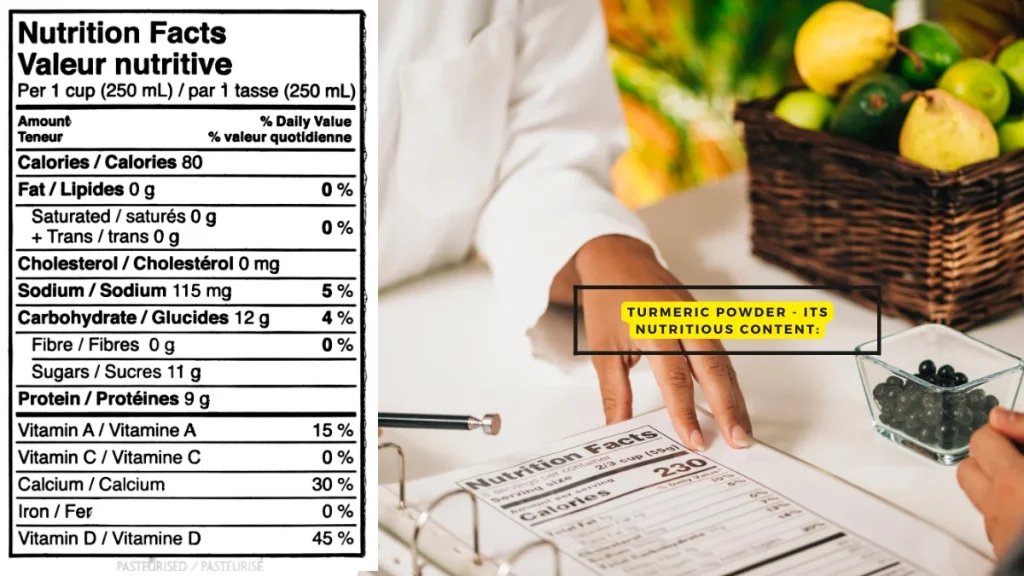
The table uses one basis: per 100 g of ground turmeric, plus a 2 g seasoning amount. Percent Daily Values (%DV) use the current FDA values.
| Nutrient | Per 100 g | %DV per 100 g | Per 2 g (calculated) |
|---|---|---|---|
| Energy | 312 kcal | n/a | 6 kcal |
| Protein | 9.68 g | n/a | 0.19 g |
| Total fat | 3.25 g | 4% | 0.07 g |
| Carbohydrate | 67.1 g | 24% | 1.3 g |
| Fibre | 22.7 g | 81% | 0.45 g |
| Total sugars | 3.21 g | n/a | 0.06 g |
| Calcium | 168 mg | 13% | 3.4 mg |
| Iron | 55.0 mg | 306% | 1.1 mg (6%) |
| Potassium | 2,080 mg | 44% | 42 mg (1%) |
| Sodium | 27.0 mg | 1% | 0.5 mg |
Why Turmeric Powder Benefits Claims Disagree
Spice is not extract. Most positive studies use curcumin extracts, not kitchen powder. NCCIH notes that curcumin supplements differ in their actual curcumin content. A curry made with a teaspoon of powder gives a very different dose from a capsule.
Better absorbed is not safer. Curcumin is poorly absorbed on its own. Black pepper contains piperine, which can increase absorption, according to NCCIH. Yet NCCIH also warns that highly bioavailable curcumin products may harm the liver. Therefore, a product that boasts higher absorption deserves more caution, not less.
Per-tablespoon figures vary. Many sites list turmeric per tablespoon. However, a tablespoon of powder weighs different amounts depending on packing and on which database entry is used. This page uses per 100 g so the numbers can be compared.
Turmeric Powder Benefits: Evidence Table
| Claim you may see | Where it stands | What it means for you |
|---|---|---|
| Eases osteoarthritis pain | Early and positive; better trials needed (NCCIH) | Ask your clinician; it does not replace treatment. |
| Works like an antidepressant | Not supported | Never swap a prescribed antidepressant for turmeric. |
| Beats anti-inflammatory drugs | Not supported | Keep taking prescribed arthritis medicine. |
| Cuts heart attack risk | Not supported | Proven heart disease prevention measures come first. |
| Prevents or treats cancer | Not supported; early work only on mouth sores from cancer treatment (NCCIH) | Tell your oncology team before using any supplement. |
| Treats or slows Alzheimer’s disease | Not supported | Lab and animal findings have not been shown in people. |
| Helps fatty liver | Early and inconsistent (NCCIH) | High-dose products can also injure the liver. |
| Slows ageing or burns belly fat | Not supported | No reliable human evidence. |
Safety: Who Should Be Careful With Turmeric
- Prescribed medicine: do not stop, skip or replace it with turmeric. If you take any medicine, ask your pharmacist or doctor before using herbal products, because some herbs and medicines interact in harmful ways.
- Liver: stop supplements and call a clinician if you notice fatigue, nausea, poor appetite, dark urine or yellow skin or eyes.
- Pregnancy: NCCIH says turmeric supplements may be unsafe in pregnancy. Little is known about amounts above normal food use while breastfeeding.
- Blood thinners and surgery: NCCIH does not list specific drug interactions. Even so, tell your clinician and pharmacist about every supplement, especially before surgery or if you take anticoagulants.
- Stomach upset: oral turmeric can cause nausea, reflux, diarrhoea or constipation.
- Duration: conventional oral turmeric is likely safe at recommended amounts for up to 2 to 3 months, per NCCIH.
- Supplement quality: in the US, the FDA does not approve supplements before sale. Contents vary, so check labels for curcumin amount and added ingredients such as piperine.
How to Use Turmeric Powder in Food
Cooking is the lowest-risk way to enjoy turmeric. Stir it into curries, lentil soups, rice or roasted vegetables. Add it to a spice rub or a marinade for colour and a warm, earthy flavour. It stains cloth and plastic, so wipe spills quickly.
Turmeric Powder Benefits: Frequently Asked Questions
As a spice, it adds colour and flavour to food. NCCIH reports early, positive research for osteoarthritis pain, but not enough evidence to call turmeric or curcumin beneficial for any health purpose.
No. Do not stop, skip or replace prescribed medicine with turmeric. Talk to your doctor or pharmacist before using any herbal product alongside a medicine.
Turmeric in normal cooking amounts is low risk. NCCIH says conventional oral turmeric or curcumin is likely safe at recommended amounts for up to 2 to 3 months. Long-term supplement use has less safety data.
Liver injury has been reported with highly bioavailable curcumin products. Warning signs include fatigue, nausea, poor appetite, dark urine and jaundice. Stop the product and contact a clinician if these appear.
NCCIH says turmeric supplements may be unsafe during pregnancy. Food amounts are a different matter, so ask your midwife or doctor about your own situation.
Piperine from black pepper can increase curcumin absorption, according to NCCIH. More absorption also means more exposure, so be cautious with supplements that add piperine.
NCCIH does not name a specific interaction. Still, tell your clinician and pharmacist about all supplements if you take blood thinners or have surgery planned.
No reliable human evidence supports this claim. Turmeric powder has 312 kcal per 100 g, but typical food amounts are tiny.
Related Reading
- How to read nutrition labels
- Heart disease prevention measures
- Foods that support the immune system
- Balancing protein, carbs and fats
Sources
- NCCIH: Turmeric, Usefulness and Safety
- Spices, turmeric, ground (USDA FDC 172231, mirror site)
- FDA: Daily Value on the Nutrition and Supplement Facts Labels
This page is for general information only. It is not medical advice. Speak to your doctor or pharmacist before using turmeric supplements, especially if you take medicine, are pregnant or have liver problems. Last reviewed and rewritten October 2026.

