

You get into bed and your brain switches on. The worry spiral starts. You replay conversations from three years ago, rehearse arguments that will probably never happen, and catastrophise about problems that may not exist. By the time you have exhausted yourself mentally, it is 2am and you are no closer to sleeping.
Overthinking at night is not a personality flaw. It is a physiological pattern – one that research has mapped clearly and that specific, evidence-based techniques can interrupt.
Whether you are searching for how to stop overthinking at night and sleep, how to stop overthinking at night when trying to sleep, or simply how to stop overthinking at night before bed, the science points to the same core interventions. This guide covers all of them.
Why Your Brain Overthinks at Night
During the day, you have external stimulation competing for your attention. Work, conversations, tasks, screens- these give your brain something to engage with. At night, when external input disappears, your default mode network (DMN) activates. This is the brain network responsible for self-referential thought – rumination, planning, replaying memories, and worrying about the future.
The DMN evolved for a purpose. Quiet time was when our ancestors processed social information, planned for future threats, and consolidated learning. The problem is that a modern, chronically stressed brain has more unresolved threats to process than the system was designed for. Every unanswered email, every unresolved conflict, every uncertain future plan becomes input for the DMN to churn through.
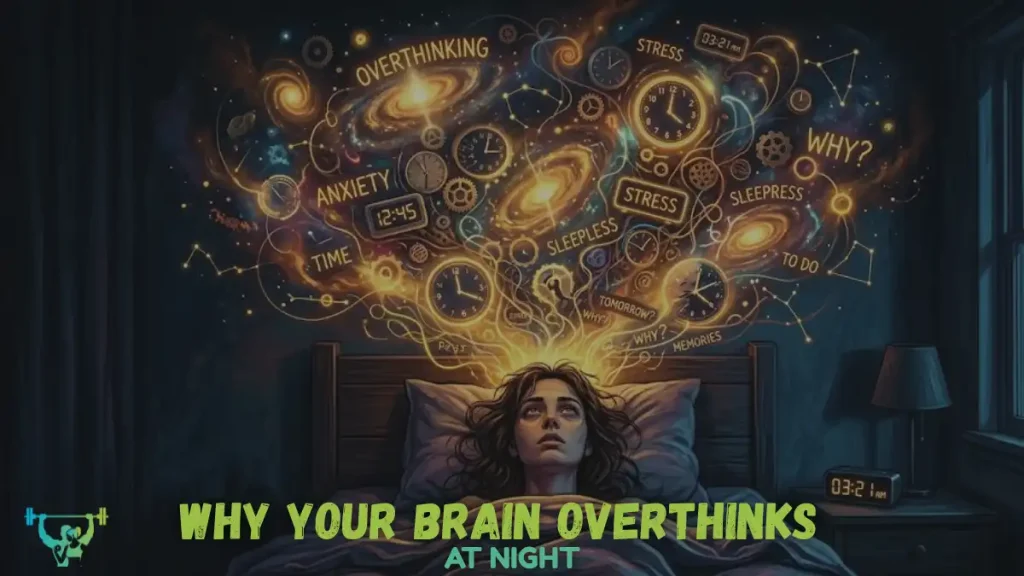
Cortisol levels also play a role. In healthy circadian rhythms, cortisol drops in the evening and rises again just before waking. In people with chronic stress, this pattern is disrupted – cortisol stays elevated into the night, keeping the brain in an alert, threat-processing state rather than allowing it to wind down. Our guide to stress management covers this cortisol pattern in more depth if daytime stress is the underlying driver.
For those dealing with how to stop overthinking at night anxiety specifically, this cortisol disruption is often more pronounced – a recognised feature of generalised anxiety disorder and chronic stress responses. Research from the Sleep Foundation confirms the bidirectional relationship between anxiety and poor sleep quality. If sleep itself, not just the overthinking, is the harder problem most nights, see our guide to improving sleep quality naturally.
Evidence-Based Techniques That Actually Work
1. Scheduled Worry Time
This sounds counterintuitive but is one of the most robust cognitive techniques for reducing nighttime rumination. Research by Penn State psychologist Michelle Newman found that scheduling a specific 20-minute window during the day for worry significantly reduced the intrusion of anxious thoughts at night.

The principle is that your brain returns to unfinished business. By deliberately giving worry a time and place during the day – writing concerns down, examining them, and then mentally closing the file – you signal to your brain that the problem has received attention and does not need to be processed at 1am.
Practical implementation: Set a timer for 20 minutes in the late afternoon. Write down every worry on your mind. For each one, write either a concrete next action or acknowledge that it is outside your control. When the timer ends, close the notebook. If worries intrude at night, remind yourself: “This has had its time. I can return to it tomorrow.”
2. Cognitive Defusion
Cognitive defusion is a technique from Acceptance and Commitment Therapy (ACT). The goal is to change your relationship to your thoughts – to observe them without being consumed by them.
Instead of “I am going to fail” (fusion – the thought feels real and true), defusion creates distance: “I am having the thought that I am going to fail.” You can extend this: “I notice my mind is telling me a story about failing.” Research shows that this linguistic shift reduces the emotional impact of intrusive thoughts significantly, even when the thought content itself does not change.
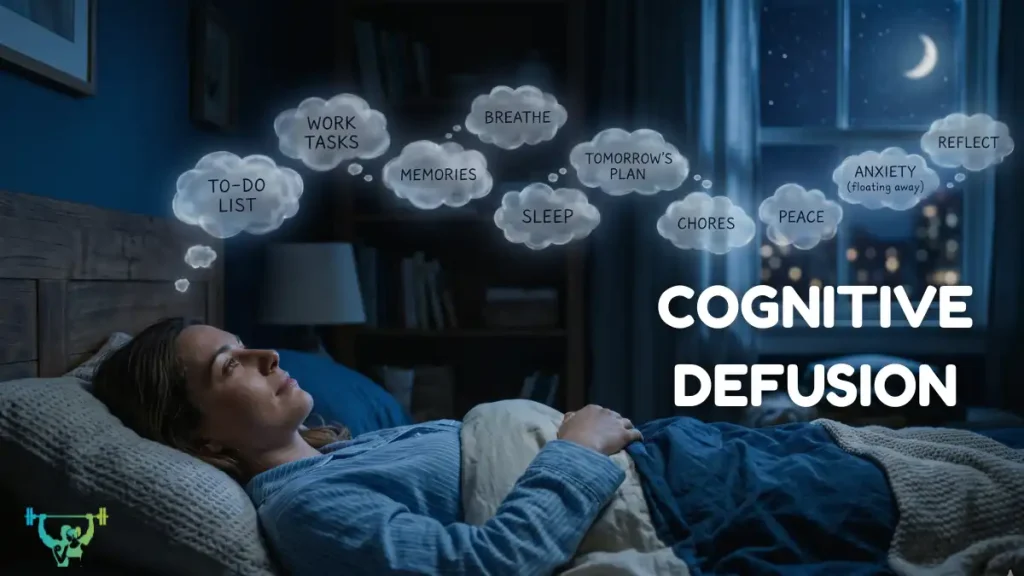
When you are lying awake with racing thoughts, try narrating them from a third-person perspective: “There is a thought about the presentation. There is a thought about the argument from last week.” You are watching the thoughts rather than being inside them.
The American Psychological Association’s research on rumination supports cognitive defusion as one of the most effective tools for breaking the overthinking cycle, particularly when practiced consistently at bedtime.
3. The Brain Dump
Keep a notebook by your bed. When you get in, spend five minutes writing down everything that is on your mind – tasks, worries, half-formed plans, things you are afraid of forgetting. The act of externalising these thoughts reduces the cognitive load your brain feels obligated to maintain. Research on this technique (sometimes called an “offloading” task) found it reduced pre-sleep cognitive arousal and improved sleep onset.

Importantly: write tasks as specific next actions, not vague worries. “Email Priya about the report” is easier for your brain to file away than “I need to sort out the work situation.” Specificity signals closure. Journalling in whichever language you naturally think in tends to create a stronger effect than forcing it into a second language.
4. Progressive Muscle Relaxation (PMR)
PMR works by systematically tensing and releasing muscle groups throughout the body. The technique interrupts the thought-body feedback loop. When your muscles are genuinely relaxed, it is physiologically difficult to maintain a state of anxious mental arousal.

Starting from your feet: tense the muscles in your feet for five seconds, then release completely for 20 seconds, noticing the contrast. Move to calves, thighs, abdomen, hands, arms, shoulders, face. By the time you have worked through the full sequence (approximately 15 minutes), most people experience a significant reduction in both physical tension and mental activity.
A 2021 meta-analysis in Sleep Medicine Reviews found PMR significantly improved sleep onset latency and sleep quality in people with insomnia. It works even better when combined with diaphragmatic breathing.
5. The 4-7-8 Breathing Technique
Developed from pranayama breathing practices, the 4-7-8 technique activates the parasympathetic nervous system – your rest-and-digest system that counteracts the fight-or-flight response of the sympathetic nervous system.

Inhale through your nose for a count of 4. Hold your breath for a count of 7. Exhale slowly through your mouth for a count of 8. Repeat four times. The extended exhale is the key mechanism – slow exhalation activates vagal tone, which reduces heart rate and cortisol levels and signals safety to your nervous system.
Research on extended-exhale breathing consistently shows reductions in anxiety, heart rate variability improvements, and faster sleep onset. It is particularly effective because it gives your mind something concrete to focus on, interrupting the rumination cycle.
6. Temperature Regulation
Your core body temperature drops as you fall asleep – this drop is both a signal and a requirement for sleep. A room that is too warm prevents this drop and keeps your brain more alert. Research consistently points to 18 to 20 degrees Celsius as optimal for sleep.

A warm shower or bath before bed seems counterintuitive but actually accelerates sleep onset by bringing blood to the skin’s surface and then causing rapid cooling as you dry off. This mimics the natural pre-sleep temperature drop and has been shown in multiple studies to reduce sleep onset time by 10 to 15 minutes.
7. Cognitive Shuffling
Developed by Canadian psychologist Luc Beaulieu-Prévost, cognitive shuffling is a technique designed to deliberately scramble your thinking to prevent coherent rumination from forming.

Think of a word – any word and then generate random, unrelated images associated with each letter. For the word “TREE”: a T-rex, a red umbrella, an elephant, an email notification. The images should be vivid and bizarre, but not emotionally loaded. The randomness prevents your brain from constructing the narrative chains that sustain worry. Users of the technique (it has been incorporated into the mySleepButton app) report falling asleep faster and with less rumination.
8. Religious and Spiritual Wind-Down Practices
Structured spiritual practice before sleep works through the same mechanism as other wind-down rituals, with an added layer of reassurance for people who hold a faith. In Islamic tradition, for example, reciting Ayat al-Kursi, the last two verses of Surah Al-Baqarah, and the three Quls (Al-Ikhlas, Al-Falaq, An-Nas) before sleep are recommended in authentic hadith. The repetitive, rhythmic recitation activates similar relaxation pathways to other evidence-based wind-down techniques, while cultivating tawakkul – trust in God – which can directly address the anxious need for control that drives rumination. The same logic applies to a rosary, an evening prayer, or any other consistent, repetitive spiritual practice a person already holds.
What Does Not Work
Trying harder to stop thinking does not work. Thought suppression – actively trying not to think about something – reliably produces a rebound effect called the ironic process, described by Harvard psychologist Daniel Wegner. Telling yourself “don’t think about the presentation” makes you think about the presentation more.
Watching your phone or scrolling social media does not work. Blue light suppresses melatonin, but more importantly, social media creates new inputs – new things to process, compare, worry about – at the exact moment you are trying to quieten your mind. Our guide to digital detox covers why screens are especially disruptive right before sleep.
Alcohol does not work. It may help you fall asleep faster but it fragments sleep architecture in the second half of the night, reducing REM sleep and leaving you less rested.
Mayo Clinic’s guidance on insomnia echoes these findings and adds that irregular sleep schedules compound the overthinking cycle by making the brain even less capable of self-regulation at bedtime.
When Overthinking Indicates a Deeper Issue
Occasional nighttime overthinking is normal and responds well to the techniques above. Persistent, severe, or worsening nighttime anxiety that significantly impairs your functioning may indicate Generalised Anxiety Disorder (GAD), which affects approximately 3 to 5 percent of adults. Signs include worry that feels impossible to control, physical symptoms like muscle tension and headaches, and anxiety that is present most days for six months or more.
Cognitive Behavioural Therapy for Insomnia (CBT-I) is the gold-standard treatment for chronic insomnia — more effective than sleep medication in the long term. If a persistent worry pattern feels less like ordinary rumination and more like an anxiety disorder, our social anxiety and adult ADHD guides cover two commonly co-occurring conditions, and our mental health guide covers when self-management stops being enough and what professional support actually looks like.
How to Stop Overthinking: A 3-Step Guide
Conclusion
Overthinking at night is a brain pattern, not a personality trait. It can be interrupted and reduced with consistent practice of evidence-based techniques. The most effective approach combines daytime strategies (scheduled worry time, brain dumps) with bedtime techniques (PMR, breathing, cognitive defusion).
Pick one or two techniques and practice them every night for two weeks before evaluating whether they are working. Consistency matters more than perfection. The goal is not to eliminate all thoughts – it is to break the cycle of sustained, distressing rumination that prevents sleep.
Frequently Asked Questions about Overthinking at Night
The most effective combination is a daytime brain dump (writing worries down before evening), followed by a bedtime routine using either PMR or 4-7-8 breathing. This addresses both the cognitive and physiological aspects of nighttime overthinking. Most people notice improvement within 7 to 14 nights of consistent practice. The key is starting the wind-down routine at least 30 minutes before you want to fall asleep, not after the spiral has already started.
When external stimulation disappears at bedtime, your brain’s default mode network activates – the system responsible for self-referential thinking, planning, and rumination. In people with chronic stress or anxiety, cortisol levels remain elevated into the night, keeping the brain in threat-processing mode rather than allowing it to wind down. This is a physiological pattern, not a character flaw, and it can be interrupted with the right techniques.
The 4-7-8 technique – inhale for 4 counts, hold for 7, exhale for 8 – is consistently supported by research for reducing pre-sleep anxiety. The extended exhale activates vagal tone, slowing heart rate and reducing cortisol. It also gives your mind a specific task to focus on, which interrupts the rumination loop. Diaphragmatic (belly) breathing in general is more effective than chest breathing for activating the parasympathetic nervous system.
If overthinking at night is tied to anxiety rather than general mental restlessness, scheduled worry time is especially important – it gives the anxious brain a legitimate window to process concerns so they do not flood in at bedtime. Cognitive defusion (observing thoughts as passing mental events rather than facts) is also particularly effective for anxiety-driven overthinking. If anxiety is persistent and severe, CBT-I and CBT for anxiety are the most evidence-backed professional interventions.
Yes. Sustained nighttime rumination keeps cortisol and adrenaline elevated, which causes physical symptoms including muscle tension, increased heart rate, shallow breathing, headaches, and digestive discomfort. Over time, chronic sleep disruption from overthinking is associated with weakened immune function, elevated inflammation markers, and increased cardiovascular risk. This is why addressing nighttime overthinking is a genuine health priority, not just a comfort issue.
Most evidence-based techniques for nighttime overthinking show measurable improvement within 1 to 2 weeks of consistent nightly practice. PMR and breathing techniques often produce some effect on the first or second night. Cognitive techniques like defusion and scheduled worry time typically build efficacy over 1 to 3 weeks as the brain learns the new pattern. Consistency matters far more than intensity – practicing imperfectly every night produces better results than doing it perfectly once a week.
References
- Harvey, A. G. (2000). Pre-sleep cognitive activity: a comparison of sleep-onset insomniacs and good sleepers. British Journal of Clinical Psychology, 39(3), 275-286.
- Newman, M. G., et al. (2011). Stimulus control therapy for worry and insomnia. Journal of Consulting and Clinical Psychology. Pennsylvania State University.
- Hayes, S. C., Luoma, J. B., Bond, F. W., Masuda, A., & Lillis, J. (2006). Acceptance and Commitment Therapy: Model, processes and outcomes. Behaviour Research and Therapy, 44(1), 1-25.
- Scullin, M. K., Krueger, M. L., Ballard, H. K., Pruett, N., & Bliwise, D. L. (2018). The effects of bedtime writing on difficulty falling asleep: A polysomnographic study comparing to-do lists and completed activity lists.
- Manzoni, G. M., Pagnini, F., Castelnuovo, G., & Molinari, E. (2008). Relaxation training for anxiety: a ten-year systematic review with meta-analysis.
- Jerath, R., Edry, J. W., Barnes, V. A., & Jerath, V. (2006). Physiology of long pranayamic breathing: Neural respiratory elements may provide a mechanism that explains how slow deep breathing shifts the autonomic nervous system. Medical Hypotheses, 67(3), 566-571.
- Okamoto-Mizuno, K., & Mizuno, K. (2012). Effects of thermal environment on sleep and circadian rhythm. Journal of Physiological Anthropology, 31(1), 14.
- Beaulieu-Prévost, D., & Zadra, A. (2015). Contextual and cognitive correlates of recurrent dreams. Sleep. (Basis for the cognitive shuffling technique.)
- Wegner, D. M., Schneider, D. J., Carter, S. R., & White, T. L. (1987). Paradoxical effects of thought suppression. Journal of Personality and Social Psychology, 53(1), 5-13.
- Morin, C. M., et al. (2006). Psychological and behavioral treatment of insomnia: update of the recent evidence (1998-2004). Sleep, 29(11), 1398-1414. (CBT-I gold standard.)
- Sleep Foundation. Anxiety and sleep.
- Mayo Clinic. Insomnia: Symptoms and causes.
- National Institute of Mental Health. Generalised anxiety disorder.
Reviewed by: the HealthCoachJP Editorial Team | Last updated: August 2026
Medical disclaimer: This article is for informational and educational purposes only and does not constitute medical advice, diagnosis or treatment. If nighttime anxiety is severe, persistent or affecting your ability to function, speak with a doctor or licensed mental health professional. See our Fact-Checking Policy.