

Quick answer: tight hamstrings can contribute to lower back pain by pulling the pelvis into a backward tilt and flattening the natural lumbar curve, but they are rarely the whole cause. The more useful question is why the hamstrings feel tight. Genuine muscle shortness responds to stretching. Tightness that is really sciatic nerve tension, or protective guarding around an irritated back, gets worse with aggressive stretching. There is a self-test below that separates the two in under a minute.
Get Urgent Care If Any of These Apply
Before stretching anything, rule these out. They need same-day assessment, not a mobility routine:
- Numbness around the groin, inner thighs or buttocks (saddle anaesthesia), difficulty passing or controlling urine, or loss of bowel control. These are red flags for cauda equina syndrome, a surgical emergency.
- Leg weakness that is getting worse, or a foot that catches or drops when you walk.
- A sudden sharp tearing sensation at the back of the thigh during sprinting or a fast movement, with bruising or difficulty weight-bearing. That is a hamstring strain, not tightness, and stretching it early can delay healing.
- Back pain with fever, unexplained weight loss, a history of cancer, or pain that is much worse at night.
Is It Really Your Hamstring? The One-Minute Self-Test
This is the most useful thing on the page, and it is the step almost every hamstring article skips. Three different things produce the same feeling of tightness at the back of the thigh, and they need opposite treatment.
How to run the test. Lie on your back. Raise one straight leg until you feel the familiar tightness. Hold it there, then do two things one at a time:
- Pull your toes towards your shin (ankle dorsiflexion).
- Return the ankle to neutral, then tuck your chin to your chest.
Neither of those movements changes the length of your hamstring by a single millimetre. Both of them tension the sciatic nerve. So if the tightness sharpens noticeably when you dorsiflex the ankle or tuck the chin, what you are feeling is largely neural, not muscular.
| What you notice | What it suggests | What to do |
|---|---|---|
| Broad, dull stretch through the belly of the thigh. Unchanged by ankle or chin position. Eases within seconds of releasing | Genuine hamstring shortness or stiffness | Stretch it. Static holds and loaded lengthening both work |
| Sharp, stringy, burning or electrical quality. Clearly worse with ankle dorsiflexion or chin tuck. May travel towards the calf or foot | Neural tension, usually lumbar nerve root irritation | Stop aggressive stretching. See our sciatica exercises guide and get assessed |
| Both hamstrings feel locked, the back is sore, and everything eases considerably once the back settles | Protective guarding around an irritated lumbar spine | Treat the back, not the hamstring. Gentle movement, and the lower back pain guide |
| Deep pain at the sitting bone, worst on sitting on a hard chair and on sprinting | Possible high hamstring tendinopathy at the ischial tuberosity | Avoid stretching into it. Needs graded loading, ideally physio-guided |
This matters practically. Stretching hard into what is actually nerve tension is one of the most common ways people make lumbar radiculopathy worse, and they usually do it in good faith because the leg genuinely feels tight.
How much range is normal?
Lying on your back with the opposite leg flat, most adults can raise a straight leg to somewhere around 70 to 80 degrees before the hamstring limits it. Below about 60 degrees is commonly described as reduced hamstring extensibility. Ranges vary a lot between individuals, so your own left-to-right difference and your change over six weeks are more informative than any published number.
Where the Hamstrings Are, and What They Do
The hamstrings are three muscles at the back of the thigh:
- Biceps femoris – the outer hamstring, with a long head and a short head
- Semitendinosus – inner and superficial
- Semimembranosus – inner and deep
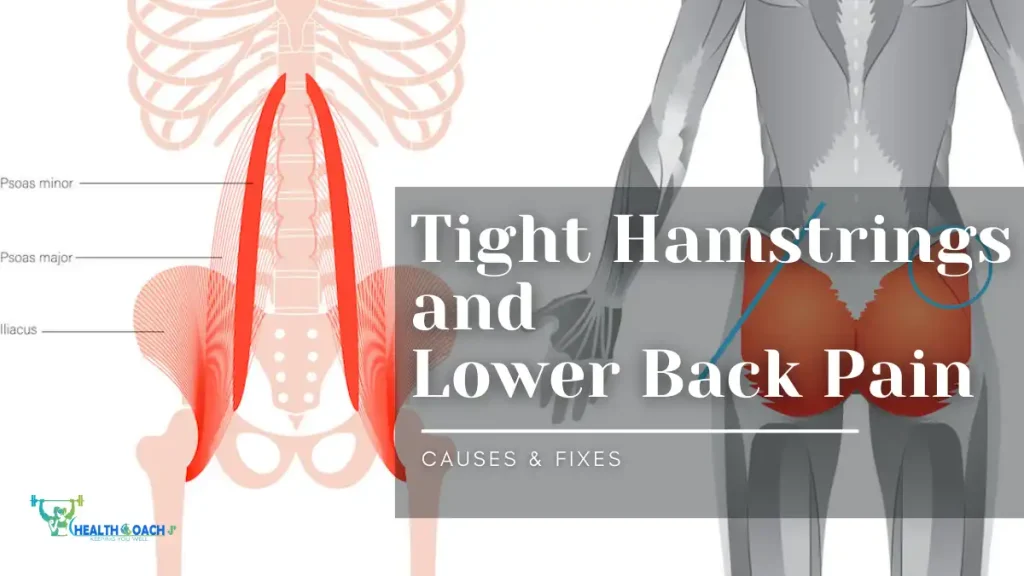
All but the short head of biceps femoris originate on the ischial tuberosity, the sitting bone at the base of the pelvis, and cross both the hip and the knee. That double-joint arrangement is the whole reason they matter to your back: a muscle anchored to the pelvis changes pelvic position, and pelvic position changes lumbar curve.
Their jobs are hip extension, knee flexion, and controlling the deceleration of the leg during walking and running. They also work with the gluteus maximus and the thoracolumbar fascia as part of the posterior chain, which is why hamstring, glute and lower back problems so often arrive together.
Can Tight Hamstrings Cause Back Pain?
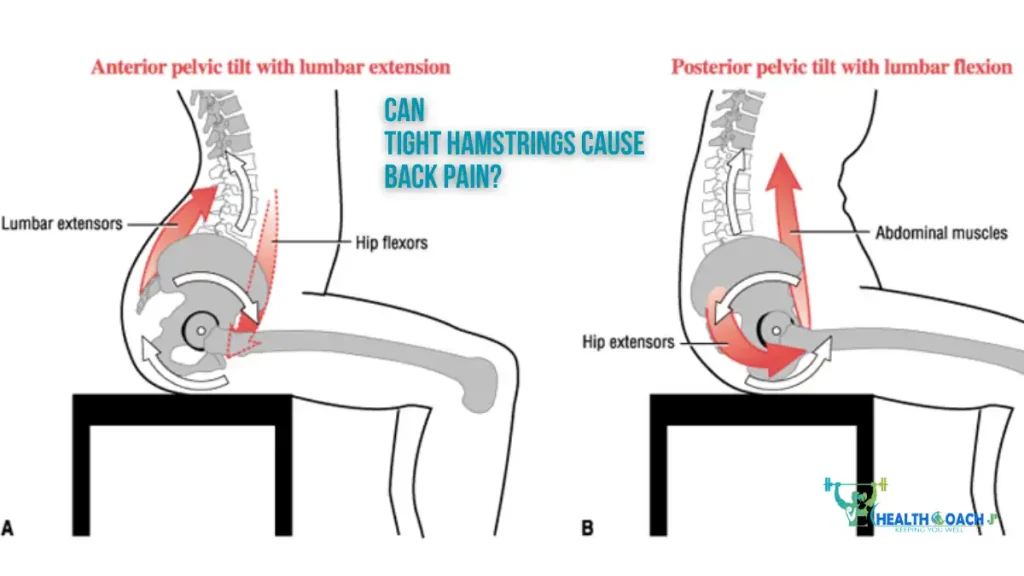
They can contribute to it, but the evidence does not support calling them a cause. Hamstring tightness is associated with low back pain across a number of studies, and shortened hamstrings do measurably reduce anterior pelvic tilt and alter lumbopelvic rhythm when you bend forward. But plenty of people with very tight hamstrings have no back pain at all, and plenty of people with excellent flexibility do. Treat it as one modifiable factor in a chain, not the explanation.
The mechanism, when it does apply, is straightforward. Shortened hamstrings pull the ischial tuberosity downward, tipping the pelvis into posterior tilt. That flattens the lumbar lordosis and shifts more load onto the discs and the posterior ligaments. It also means that when you bend to pick something up, movement that should be shared between hips and spine is taken disproportionately by the lumbar spine.
What Makes Hamstrings Tight
- Prolonged sitting. Hours with the hip flexed and the knee bent keeps the muscle in a shortened position. An inactive job alone is enough.
- Loading without full range. Cycling, rowing and heavy squatting to partial depth all train the hamstrings in a limited range.
- Previous hamstring strain. Scar tissue and altered muscle architecture reduce extensibility, and reinjury rates are high in the first months.
- Weakness. A weak muscle often behaves like a tight one. Low strength through range produces protective stiffness that does not resolve with stretching.
- Neural tension from lumbar nerve root irritation, which reads as tightness but is not.
- Individual variation. Resting muscle length differs substantially between people and is partly genetic.
Five Hamstring Stretches That Are Safe for a Sore Back
Stretch to gentle tension, never sharp pain. Stop if any of these increases your back pain, or sends symptoms further down the leg. Symptoms retreating towards the buttock is a good sign; symptoms travelling towards the foot is a stop signal.
1. Towel or strap stretch, lying on your back
- Lie on your back with one knee bent and that foot flat on the floor.
- Loop a towel or strap around the other foot and raise that leg, keeping the knee softly straight.
- Hold 20 to 30 seconds, two or three times per leg.
- Why start here: the floor supports the lumbar spine, so this is the gentlest option when the back is irritable.
2. Legs up the wall
- Lie with your buttocks close to a wall and rest one or both legs up it.
- Straighten the knee only as far as is comfortable. Move further from the wall to reduce the stretch.
- Hold 30 seconds or longer. This is a low-intensity option you can do for several minutes.
3. Seated stretch with the leg supported
- Sit on a chair and rest one heel on a second chair or low stool in front of you.
- Keep the spine long and hinge forward from the hips rather than rounding the back.
- Hold 20 to 30 seconds. The hip hinge is the point of the exercise; rounding the spine just moves the stretch into the lumbar tissues.
4. Half-kneeling hamstring reach
- From half-kneeling, straighten the front leg with the heel on the floor and toes up.
- Hinge forward at the hip, keeping the back flat.
- Hold 20 to 30 seconds. Useful because it trains the hip hinge pattern at the same time.
5. Standing forward bend with a caution
- Stand tall, feet hip-width apart, and fold forward slowly with a soft bend in the knees.
- Skip this one entirely if you have acute back pain, a known disc problem, or flexion-aggravated symptoms. Loaded forward bending is the stretch on this list most likely to make both worse, and it is also unsuitable if you have low bone density.
Why Strengthening Beats Stretching Over Time
Stretching produces a real but short-lived change in perceived tightness, largely through altered stretch tolerance rather than a permanent change in muscle length. Strength work through a long range produces a more durable improvement in both range and function, and it addresses the weakness that often underlies the stiffness in the first place.
- Hip hinge patterning – a broomstick along the spine to keep three points of contact while you bow forward from the hips. This is the movement skill that protects the back when you lift.
- Romanian deadlift with light load – trains the hamstrings in a lengthened position, which improves extensibility more reliably than static stretching.
- Glute bridge, progressing to single leg – because the gluteus maximus should be doing a share of the hip extension the hamstrings are covering for.
- Nordic hamstring curl – strong evidence for reducing hamstring injury rates, but demanding. Start with a small range and a partner or a fixed anchor, and only once you are pain-free.
Two or three sessions a week is enough. Our at-home exercises for lower back pain set this out as a phased plan.
Particular Situations
| If you are | Prioritise | Go easy on |
|---|---|---|
| A desk worker | Position changes every 30 to 45 minutes, the strap stretch, hip hinge practice | One long stretching session used to make up for eight static hours |
| A runner or field-sport player | Nordic curls and eccentric strength work, dynamic warm-up | Long static holds immediately before sprinting |
| Recovering from a hamstring strain | Graded loading under guidance, patience through the first six weeks | Stretching into pain, and returning to sprinting early |
| Experiencing pain below the knee | Running the nerve-tension self-test above, then the sciatica guide | All aggressive hamstring stretching until assessed |
| Over 60 or with low bone density | Supported lying and seated stretches | Standing forward bends and any loaded spinal flexion |
| Pregnant | Supported side-lying or seated options, gentle range | Deep stretching into end range, since ligament laxity is already increased |

When to See a Doctor or Physiotherapist
- Pain persisting beyond two to three weeks, or getting worse rather than better.
- Pain, numbness or pins and needles travelling below the knee.
- Tightness that is one-sided and has not shifted at all after six weeks of consistent work.
- Deep sitting-bone pain that is worse on hard chairs and on driving.
- Any of the urgent red flags listed at the top of this page.
Related reading: our lower back pain guide for the full picture, back pain when walking or standing if symptoms are worst upright, sacroiliac joint pain if the pain is one-sided and low, and hunchback posture and kyphosis for the upper end of the same chain.
Terms You May Hear
| Term | What it means |
|---|---|
| Ischial tuberosity | The sitting bone. The common origin of the hamstring group |
| Posterior pelvic tilt | The pelvis rotating backwards, which flattens the lumbar curve |
| Lumbopelvic rhythm | How movement is shared between the hips and the lumbar spine when you bend forward |
| Straight leg raise | A test of hamstring extensibility that also loads the sciatic nerve, which is why interpretation matters |
| Neural tension | Symptoms produced by movement of the nerve rather than the muscle. Changes with ankle and neck position |
| Eccentric loading | Strengthening a muscle while it lengthens under load. The basis of Nordic curls and Romanian deadlifts |
| Stretch tolerance | How much lengthening you will accept before it feels like too much. Most short-term stretching gains are this rather than true length change |
| Posterior chain | The hamstrings, glutes, spinal extensors and the fascia connecting them, working as a functional unit |
Frequently Asked Questions
Shortened hamstrings pull the sitting bones downward and tilt the pelvis backwards, which flattens the lumbar curve and shifts load onto the discs and posterior ligaments. It also means bending forward takes more movement from the lumbar spine and less from the hips. This is one plausible contributor rather than a complete explanation, since back pain usually has several factors.
Raise the straight leg until you feel the tightness, then pull your toes towards your shin, and separately tuck your chin to your chest. Neither movement changes hamstring length, but both tension the sciatic nerve. If the tightness sharpens noticeably with either, it is largely neural rather than muscular, and aggressive stretching is likely to make it worse.
Usually not. Stretching produces a real but short-lived change in how tight the muscle feels, mostly by increasing stretch tolerance rather than lengthening tissue permanently. Strength work through a long range, staying generally active, and changing how long you hold one position tend to matter more over months.
Daily is reasonable, holding each position 20 to 30 seconds and repeating two or three times per leg. Consistency matters more than intensity, and it should never be painful. If nothing has changed after six weeks of consistent work, the limiting factor is probably not muscle length.
Lying on your back with the other leg flat, most adults reach somewhere around 70 to 80 degrees before the hamstring limits it, and under about 60 degrees is commonly described as reduced. Individual variation is wide, so a left-to-right difference or a change in your own measurement over six weeks tells you more than the absolute number.
Use dynamic movement such as leg swings and walking lunges as a warm-up, and save longer static holds for after activity or as a separate session. Long static stretching immediately before sprinting or jumping can temporarily reduce power output, which matters for athletes and not much for anyone else.
A persistent one-sided difference is worth investigating rather than stretching harder. Common explanations include an old hamstring strain, a difference in hip mobility, nerve root irritation on that side, or a sacroiliac joint problem. If six weeks of even work has not evened it out, get it assessed.
Prolonged sitting keeps the hamstrings in a shortened position with the hip flexed and the knee bent, and reduces the range they move through in a day. That is enough to leave them feeling stiff. The most effective countermeasure is frequent position change rather than one long stretching session at the end of the day.
Sources
- PubMed – Hamstring stretching and outcomes in low back pain
- PMC – Hamstring flexibility, pelvic motion and lumbar mechanics
- National Institute of Neurological Disorders and Stroke – Low Back Pain
- National Institute of Arthritis and Musculoskeletal and Skin Diseases – Back Pain
- MedlinePlus – Sciatica
- NICE guideline NG59 – Low back pain and sciatica in over 16s
Last updated: August 2026. Written by Aisha Desai, who writes on back and musculoskeletal topics and is not a clinician. This page has been reviewed for accuracy by our editorial team but has not been reviewed by a named clinician. It is general information, not a diagnosis or a treatment plan. See a doctor or physiotherapist for back pain that is severe, persistent, worsening, or accompanied by any of the red flag symptoms above.