

Quick answer: exercise is the best-supported non-surgical treatment for sciatica, and rest is not. The most useful early moves are gentle ones that reduce nerve tension without provoking leg symptoms. The rule that matters more than any individual exercise: pain that stays in the back or buttock during a movement is usually acceptable, pain that travels further down the leg is not. That signal, called centralisation, should guide every session.

Stop and Get Urgent Care If Any of These Apply
- Loss of bladder or bowel control, or difficulty starting to pass urine
- Numbness around the groin, inner thighs or buttocks, or new numbness during sex
- Weakness in both legs, or weakness that is getting worse over hours or days
- Symptoms in both legs at once
- Severe pain that no position relieves, or back pain with fever, unexplained weight loss or a history of cancer
These can indicate cauda equina syndrome or another serious cause. Go to an emergency department the same day rather than starting a programme of movement.
The Rule That Matters More Than the Exercise List
Most sciatica articles hand you ten exercises and leave you to guess whether what you are feeling is progress. The thing physiotherapists actually watch is the direction the symptoms travel.
- Symptoms moving up and in, out of the calf and into the thigh, or out of the leg and into the buttock or back, is a good sign, even if the back itself feels temporarily more sore. This is called centralisation. Keep going.
- Symptoms moving down and out, further into the leg or foot, or new numbness or pins and needles appearing, is a bad sign. Stop that movement, even if it appears on this page.
- Judge by where the symptoms are 20 minutes later, not by how it felt during the movement itself. A stretch that feels fine but leaves your calf buzzing an hour later is not working for you.
This is why no single exercise list suits everyone with sciatica. The underlying cause differs, and the same stretch that relieves one person aggravates another. Use the rule above to sort which is which for you.
Which Nerve Root? A Three-Movement Self-Check
Sciatica is not one condition. It is a symptom produced by irritation of a specific lumbar or sacral nerve root, and which root is involved changes where you feel it and which muscles weaken. Three simple movements give you a usable indication, and describing the result to a clinician is far more useful than saying your leg hurts.
| Try this | What it tests | If it is difficult or weak |
|---|---|---|
| Walk on your heels across a room, toes lifted off the floor | Ankle dorsiflexion, driven by tibialis anterior | Points towards L4 to L5 involvement. This is the pattern behind foot drop and needs prompt assessment |
| Walk on your toes, heels raised, or do ten single-leg calf raises | Ankle plantarflexion, driven by the calf | Points towards S1 involvement. Compare sides, since a subtle difference shows up in the calf raise before it shows up in walking |
| Lift your big toe against resistance from your own hand | Extensor hallucis longus | Points towards L5, the most commonly affected root in disc-related sciatica |
Where you feel the numbness fits the same map. Symptoms over the top of the foot and the big toe suggest L5. Symptoms into the outer foot, the little toe and the sole suggest S1. Symptoms on the inner shin suggest L4.
Two cautions. This is a rough guide, not a diagnosis, and nerve supply overlaps between people. And any weakness you can actually detect yourself is worth having assessed rather than exercised through, particularly if it is new or increasing.
Is It Actually Sciatica?
Plenty of buttock and leg pain gets called sciatica when the mechanism is different, and the treatment differs accordingly.
| Pattern | More likely | Where to go next |
|---|---|---|
| Pain travelling below the knee, often to the foot, with numbness or pins and needles, worse on coughing or sneezing | True lumbar radiculopathy, usually disc-related | This page |
| Pain stopping at the buttock or back of the thigh, no numbness, no symptoms below the knee | Referred pain from the joints or muscles rather than a nerve root | Lower back pain guide |
| One-sided pain just below and inside the dimple, worse on stairs, single-leg standing and rolling in bed | Sacroiliac joint | Sacroiliac joint pain |
| Both legs heavy or cramping after a predictable walking distance, relieved by sitting or leaning forward | Neurogenic claudication from spinal stenosis | Back pain when walking or standing |
| Tightness at the back of the thigh that sharpens when you pull your toes up or tuck your chin | Neural tension rather than a short hamstring | Tight hamstrings and lower back pain |
| Sharp jolt into the leg specifically on coughing, sneezing or straining | A pressure-sensitive cause inside the spinal canal | Back pain when coughing |
Why Exercise Rather Than Rest
Sciatica is pain, and sometimes tingling, numbness or weakness, caused by irritation or compression of a lumbar nerve root, most often by a disc herniation. Roughly 13 to 40 percent of people experience it at some point in life.
Prolonged bed rest consistently produces worse outcomes than staying active. Movement maintains the mobility of the nerve and its surrounding tissue, keeps the supporting muscles from deconditioning, and reduces the fear of movement that drives a lot of long-term disability. Guidelines are consistent that the first six to eight weeks of sciatica should be managed conservatively unless there are red flags.
What movement does not do is mechanically suck a disc back into place, and no stretch removes a herniation. It creates the conditions in which the body’s own resolution of the problem can happen while you stay functional. Herniated disc material does frequently shrink on its own over months, which is the real reason time and patience work.
Phase 1: Early Exercises, Weeks 1 to 2
While pain is high, the aim is gentle movement, not stretching into range. Work well short of the point where leg symptoms increase.
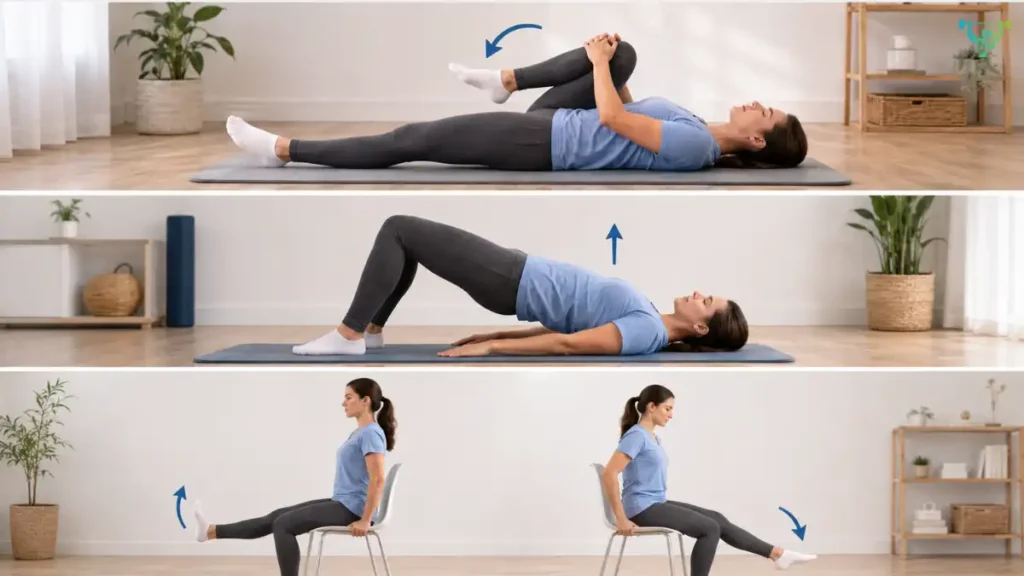
1. Knee to chest
Why: a low-load way to move the lumbar spine and hip without loading them.
How: lie on your back, both knees bent, feet flat. Draw one knee gently towards your chest with both hands. Hold 20 to 30 seconds, lower slowly, repeat on the other side. Three each side, twice daily.
Stop if: leg symptoms increase or travel further down.
2. Figure-four stretch
Why: targets the deep hip rotators including piriformis. Worth trying, but note the caveat below.
How: lie on your back, knees bent. Cross your right ankle over your left knee. Gently push the right knee away while drawing the left thigh towards you. Hold 30 seconds. Three each side.
Caveat: true piriformis syndrome is a minority cause of sciatica. Most sciatica comes from the nerve root at the spine, not from the piriformis muscle. This stretch helps some people considerably and does nothing for others, and which group you are in is informative.
3. Pelvic tilt
Why: gentle activation of the deep abdominal muscles with almost no spinal load.
How: lie on your back, knees bent. Flatten your lower back towards the floor by drawing the lower abdomen in. Hold 5 seconds, release. Ten repetitions.
4. Child’s pose, or propped extension
Why: a comfortable resting position that many people find eases symptoms.
How: kneel, sit your hips back towards your heels, walk your hands forward until your forehead rests on the floor or a cushion. One to two minutes of slow breathing.
Note: a substantial minority of people with sciatica feel worse in flexion and better in gentle extension, such as lying face down propped on the forearms. If that is you, use that instead and build it up gradually. This is the clearest example of why the centralisation rule beats a fixed list, and it is worth testing both directions deliberately in the first week so you know which one you are.
Phase 2: Building Capacity, Weeks 2 to 4
5. Bird dog
Why: trains the back extensors and glutes to hold the spine steady while the limbs move, which is what they do in daily life.
How: on hands and knees, wrists under shoulders, knees under hips. Extend the right arm and left leg together, keeping the pelvis level and the back flat. Hold 5 seconds, return, alternate. Ten each side.
6. Glute bridge
Why: builds hip extension strength, which reduces how much work the lower back does when you stand, walk and lift.
How: lie on your back, knees bent, feet hip-width. Press through the feet and lift the hips until shoulders, hips and knees line up. Hold 2 seconds, lower with control. Fifteen repetitions, two sets. Technique detail in our bridge exercise guide.
7. Sciatic nerve glide
Why: nerves need to slide relative to surrounding tissue as you move. Gliding techniques aim to restore that movement. The evidence for them is mixed rather than strong, so treat this as worth trying rather than essential.
How: sit on a chair. Straighten the affected leg while looking up, then bend the knee while looking down. Alternate slowly, ten to fifteen times.
Stop if: symptoms travel further down the leg. This should feel like gentle tension, never sharp pain. A glide is a slow oscillation through range, not a stretch held at the end of it, and treating it like a stretch is the usual way people aggravate themselves with this one.
8. Standing hamstring stretch
Why: hamstring flexibility affects pelvic position and how the lumbar spine is loaded. See our piece on tight hamstrings and lower back pain for the mechanism, and for the test that tells you whether the tightness is muscular or neural.
How: place the heel of the affected leg on a low step, knee straight. Hinge forward from the hips, back straight, until you feel a stretch behind the thigh. Hold 30 seconds, three times each side.
Important: during an irritable phase, aggressive hamstring stretching tensions the sciatic nerve directly and can make things worse. Go gently, and back off if the leg symptoms increase.
Phase 3: Strength and Prevention, Week 4 Onwards
9. Side-lying clamshell
Lie on your side, hips and knees bent to about 45 degrees. Keeping the feet together, lift the top knee. Hold 2 seconds, lower. Fifteen each side. Builds hip abductor strength, which controls pelvic position during walking.
10. Dead bug
Lie on your back, arms pointing at the ceiling, knees bent at 90 degrees. Lower the right arm and left leg towards the floor while keeping the lower back flat, then return and alternate. Ten each side. Trains trunk control with minimal spinal load.
For general back conditioning once symptoms settle, our at-home exercises for lower back pain cover the broader programme.
What to Avoid
- Long uninterrupted sitting. Get up and move for a couple of minutes every 30 to 45 minutes. The frequency of the breaks matters more than the chair.
- Repeated bending and lifting with a rounded back during the irritable phase.
- Aggressive end-range stretching, particularly of the hamstrings, while leg symptoms are active.
- Running, jumping and other high-impact work until leg symptoms have settled.
- Extended bed rest. The single most consistently unhelpful thing you can do.
How Long It Actually Takes: The Honest Answer
Most pages on this topic tell you 80 to 90 percent of sciatica resolves within a few weeks. The trial evidence is less tidy, and you deserve the real figures.
The general course of acute sciatica is genuinely favourable, and most people improve substantially. But in one large cohort, around a third of conservatively treated patients still described their symptoms as very or extremely bothersome at six months. Long-term follow-up of a major randomised trial found a small proportion who never really recovered and a further group whose symptoms continued to fluctuate for years, whether they had surgery or not.
Why this matters practically: if you are eight weeks in and not fully better, you are not failing at your exercises and you are not unusual. That is a normal point at which to go back to a physiotherapist and have the programme reassessed, rather than a reason to give up or to assume surgery is now inevitable. Trials comparing early surgery with prolonged conservative care for severe persistent sciatica found broadly similar outcomes a year later, which is why the standard advice is to give conservative treatment a proper run first.
Terms You May Hear
| Term | What it means |
|---|---|
| Sciatica | The common name for symptoms travelling along the sciatic nerve pathway. A description, not a diagnosis |
| Lumbar radiculopathy | The clinical term: symptoms caused by irritation or compression of a specific nerve root |
| Centralisation | Symptoms retreating out of the leg towards the back or buttock. The signal that a movement is working |
| Peripheralisation | Symptoms spreading further down the limb. The signal to stop |
| Disc herniation | Nucleus material pushing through the outer ring of the disc, where it can irritate a nearby nerve root |
| Dermatome | The area of skin supplied by a single nerve root. The reason numbness location indicates which root is involved |
| Foot drop | Weakness of ankle dorsiflexion causing the foot to catch when walking. Needs prompt assessment |
| Straight leg raise | A test that tensions the sciatic nerve, used to help confirm nerve root involvement |
| Neural glide | A slow oscillating movement intended to restore the nerve’s ability to slide, rather than to stretch it |
Frequently Asked Questions
Exercise, within limits. Prolonged bed rest consistently produces worse outcomes than staying active. Keep moving, avoid the specific positions that push symptoms further down the leg, and use gentle movement early rather than waiting for the pain to disappear first. The exception is significant or worsening weakness, or any of the red flags listed above, which need assessment rather than exercise.
Watch which way the symptoms travel. Pain retreating up the leg towards the buttock and back is a good sign, even if the back feels temporarily more sore. Pain spreading further down the leg, or new numbness and pins and needles, means stop. Judge by where the symptoms sit about twenty minutes afterwards rather than by how the movement felt at the time.
Three movements give a rough indication. Difficulty walking on your heels suggests L4 to L5 involvement. Difficulty walking on your toes or doing single-leg calf raises suggests S1. Weakness lifting the big toe against resistance suggests L5, the root most often affected in disc-related sciatica. Numbness location fits the same map: top of the foot and big toe for L5, outer foot and sole for S1, inner shin for L4. Any weakness you can detect yourself is worth having assessed rather than exercised through.
The course is generally favourable and most people improve substantially over the first six to twelve weeks. It is less uniform than commonly claimed, though. In one large cohort around a third of conservatively treated patients still found their symptoms very or extremely bothersome at six months, and a smaller group have symptoms that fluctuate for years. If you are still limited at eight weeks, that is a reason to have your programme reassessed, not a sign you have failed.
For most people, yes, and it is one of the easiest ways to stay active without loading the spine heavily. Start with ten to fifteen minutes on flat ground at a comfortable pace and build gradually. If pain below the knee reliably worsens as you walk, shorten the distance and mention the pattern to a clinician, because it is diagnostically useful.
Side-lying with a pillow between the knees suits most people, usually on the unaffected side, because it keeps the pelvis neutral. A pillow under the knees when lying on your back is another option. Sleeping face down tends to be the least comfortable. There is no single correct position, so use the one that lets you sleep, since sleep itself affects pain sensitivity.
The distinguishing feature is how far the symptoms travel and whether the nerve is involved. Sciatica typically goes below the knee and brings numbness or pins and needles with it, and is often worse on coughing or straining. Sacroiliac joint pain usually sits just below and inside the dimple, stays in the buttock and upper thigh, and is provoked by stairs, standing on one leg and rolling over in bed. They can coexist, so persistent one-sided pain is worth examining properly.
Go to an emergency department the same day for bladder or bowel changes, numbness around the groin or inner thighs, weakness in both legs, or rapidly worsening weakness. See a doctor or physiotherapist within a week or two if the pain is severe, if it is getting worse rather than better, if you have noticeable weakness in the foot or ankle, or if both legs are affected.
For the wider picture on lower back pain, including causes and treatment beyond sciatica, see our lower back pain guide.
Sources
- NHS — Sciatica.
- Mayo Clinic — Sciatica: Diagnosis and Treatment.
- MedlinePlus — Sciatica.
- NICE guideline NG59 — Low back pain and sciatica in over 16s: assessment and management.
- Peul WC, van Houwelingen HC, van den Hout WB, et al. Surgery versus prolonged conservative treatment for sciatica. New England Journal of Medicine, 2007.
- Lequin MB, Verbaan D, Jacobs WCH, et al. Surgery versus prolonged conservative treatment for sciatica: 5-year results of a randomised controlled trial. BMJ Open.
- Sciatica — clinical review, PubMed, on diagnosis and the conservative treatment window.
- Systematic review of prognostic factors for work participation in patients with sciatica. PMC.
Last updated: August 2026. Written by Aisha Desai, who covers back and musculoskeletal topics and is not a clinician. This page has been reviewed for accuracy by our editorial team but has not been reviewed by a named clinician, and we do not claim otherwise. It is general information rather than a personal treatment plan. Sciatica has several possible underlying causes that respond to different approaches, so please have your own symptoms assessed by a doctor or physiotherapist before starting a programme.