

Quick Answer: Kidney failure means the kidneys can no longer filter blood well enough to keep the body in balance. There are two forms: acute kidney injury, which develops over hours to days and can sometimes recover, and chronic kidney disease, which develops over months to years and does not reverse but can often be slowed. Diagnosis needs two tests, not one a blood test for eGFR and a urine test for albumin (uACR) because eGFR alone can miss early damage. Diabetes and high blood pressure cause most cases in US adults. Treatment ranges from medicines that slow decline (ACE inhibitors/ARBs, SGLT2 inhibitors, finerenone) to dialysis or a kidney transplant once function drops below about 15%.
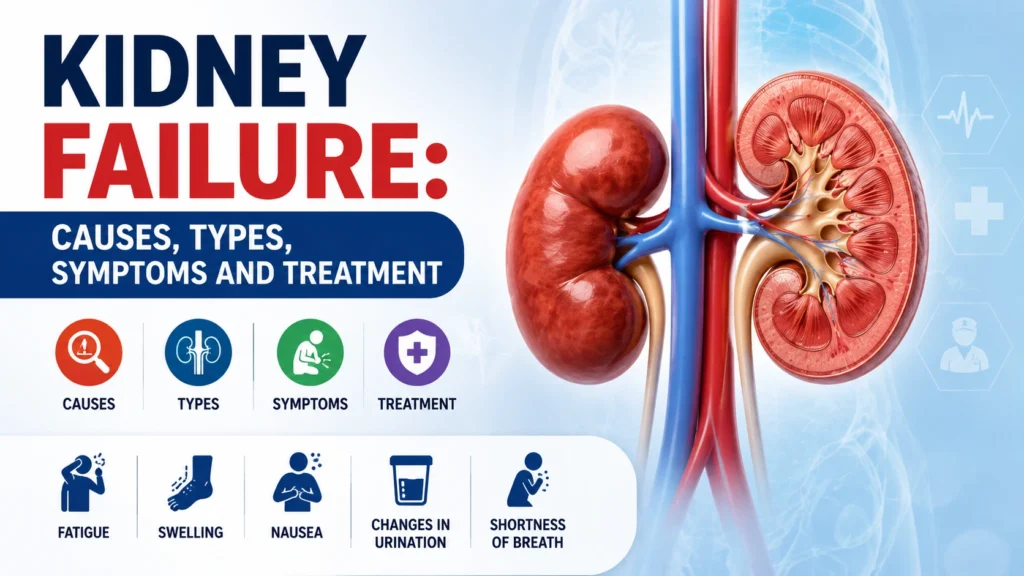
Kidney failure means the kidneys have lost enough function that they can no longer filter blood well enough to keep the body in balance. It comes in two very different forms: acute kidney injury, which develops over hours to days and is sometimes reversible, and chronic kidney disease, which develops over months to years and is not reversible but can often be slowed. Roughly 14% of US adults, about 37 million people, have chronic kidney disease, and about 87% of them do not know it.
When Kidney Symptoms Need Urgent Care
Most kidney disease is silent and is found on a routine blood test. A small number of situations are not routine. Seek same-day medical care, or go to an emergency department, if you have any of the following:
- You have passed little or no urine for a day, or you cannot urinate at all
- New shortness of breath, especially when lying flat, alongside swelling in the legs
- Confusion, drowsiness that is hard to shake, or a seizure
- Visible blood in the urine
- Severe vomiting or diarrhea that has left you unable to keep fluids down, particularly if you take blood pressure or diabetes medicines
- Severe flank or back pain with fever
High potassium, which kidney failure can cause, can trigger a dangerous heart rhythm without producing any warning symptom you would notice. That is why a clinician, not an article, decides how urgent your situation is.

What Is Kidney Failure?
Kidney failure, also called renal failure, is the point at which kidney function drops far enough that waste products, fluid and minerals build up in the blood. Three terms get used loosely in everyday writing, and they mean different things:
- Acute kidney injury (AKI) is a sudden drop in kidney function over hours or days. It is common in hospitals, particularly in intensive care, and it is often triggered by something else going wrong in the body: severe infection, major surgery, dehydration, blood loss or a medication. Doctors identify it by a rise in blood creatinine or a fall in urine output. Depending on the cause and how quickly it is treated, kidney function can recover partly or fully.
- Chronic kidney disease (CKD) is damage to kidney structure or function that has been present for more than three months. It usually progresses slowly, over years. Lost function does not come back, but the rate of decline can often be slowed considerably.
- End-stage kidney disease (ESKD), sometimes called stage 5 or established kidney failure, is the point at which kidney function is too low to sustain life without dialysis or a transplant.
The two are linked in both directions. Long-standing chronic kidney disease makes an acute injury more likely and more damaging. An episode of acute kidney injury, even one that appears to resolve, raises the long-term risk of developing chronic kidney disease, which is why guidelines advise a follow-up kidney check about three months after an AKI episode rather than assuming the matter is closed.
What Do the Kidneys Actually Do?
The kidneys are two bean-shaped organs, each roughly the size of a fist, sitting either side of the spine below the ribcage. Filtering waste into urine is the job everyone knows about, but it is only part of the work. The kidneys also:
- Control the balance of water, sodium, potassium, calcium and phosphorus in the blood
- Help regulate blood pressure, partly through the renin-angiotensin system
- Produce erythropoietin, the hormone that tells bone marrow to make red blood cells
- Activate vitamin D, which is why advanced kidney disease affects bone health
- Keep blood acidity within a narrow range
That list explains why the symptoms of advanced kidney disease look so scattered. Anemia, bone problems, high blood pressure and fluid overload are not separate illnesses that happen to appear together. They are the downstream effects of losing a single organ system that was quietly doing five jobs at once.
One healthy kidney can do the work of two. That is why living kidney donation is possible, and why some people go decades without knowing they have only one functioning kidney.

The Types of Kidney Failure, Properly Sorted
Clinicians use two separate classification systems, one for acute kidney injury and one for chronic kidney disease. Mixing them is where most consumer health articles go wrong.
Acute kidney injury is sorted by where the problem sits
- Prerenal: the kidneys themselves are undamaged, but not enough blood is reaching them. Causes include dehydration, severe bleeding, heart failure, liver failure and sepsis. This is the most common type in hospital, and the one most likely to recover if the underlying problem is corrected quickly.
- Intrinsic (or intrarenal): the filtering tissue is damaged directly. Causes include prolonged lack of blood flow, certain medications and contrast dyes, severe infection, glomerulonephritis, autoimmune disease such as lupus, and muscle breakdown releasing myoglobin into the blood.
- Postrenal: urine cannot get out. Causes include an enlarged prostate, kidney or bladder stones, blood clots, and tumors of the bladder, prostate, colon or cervix pressing on the urinary tract. Relieving the blockage often restores function, and the sooner it is relieved the better the outcome.
Chronic kidney disease is sorted by two numbers, not by location
CKD is staged on filtration rate (the G stages) and on how much protein is leaking into the urine (the A categories). Both matter. Someone with mildly reduced filtration but heavy protein leak can be at higher risk than someone with lower filtration and no leak.
| Stage | eGFR (mL/min/1.73m²) | What it means |
|---|---|---|
| G1 | 90 or above | Normal filtration, but kidney damage present (for example protein in urine) |
| G2 | 60 to 89 | Mildly reduced, with evidence of damage |
| G3a | 45 to 59 | Mild to moderate reduction |
| G3b | 30 to 44 | Moderate to severe reduction |
| G4 | 15 to 29 | Severely reduced; planning for dialysis or transplant usually begins |
| G5 | Below 15 | Kidney failure |
The albuminuria categories run alongside: A1 is normal to mildly increased (under 30 mg of albumin per gram of creatinine), A2 is moderately increased (30 to 300), and A3 is severely increased (above 300). An eGFR in the 80s with an A3 result is a more urgent picture than an eGFR in the 50s with an A1 result.
What the “5 types of kidney failure” list gets wrong
A widely copied list splits kidney failure into five types: acute prerenal, acute intrinsic, chronic prerenal, chronic intrinsic and chronic post-renal. It reads tidily, and this page previously used it, but it is not how kidney disease is classified in practice and it creates two problems.
First, it crosses two systems that answer different questions. Prerenal, intrinsic and postrenal describe where an acute injury sits. G1 to G5 and A1 to A3 describe how far advanced chronic disease is. Bolting “chronic” onto the acute categories produces labels no nephrologist stages a patient with.
Second, it leaves readers looking for the wrong thing. If you have chronic kidney disease, the numbers that determine your treatment and your risk are your eGFR and your urine albumin-to-creatinine ratio. Knowing which of five type names to apply to yourself changes nothing. Knowing your two numbers changes a great deal.
Symptoms of Kidney Failure
Early chronic kidney disease usually produces no symptoms at all. This is not a case of symptoms being subtle or easy to miss. In stages 1 and 2, and often well into stage 3, there is genuinely nothing to feel. CDC estimates that about 87% of US adults with chronic kidney disease do not know they have it, and that figure is a direct consequence of the disease being silent while it is still most treatable.

Once function is substantially reduced, symptoms may include:
- Swelling in the ankles, feet, legs or around the eyes from fluid retention
- Passing less urine than usual, or in some cases needing to urinate more often at night
- Foamy or bubbly urine, which can indicate protein leaking through the filters
- Fatigue and weakness, often from anemia
- Shortness of breath from fluid in the lungs
- Poor appetite, nausea, or a metallic taste
- Persistent itching and dry skin
- Muscle cramps, particularly at night
- Difficulty concentrating, poor sleep, or low mood
- High blood pressure that is getting harder to control
Every item on that list has many possible causes other than kidney disease. Tired and itchy is not a diagnosis. The point of the list is not self-assessment; it is knowing when to ask for a kidney check rather than assuming you are simply run down.
The Two Tests That Actually Find Kidney Disease
This is the part most articles skip, and it is the most useful thing on this page. Kidney disease is diagnosed with two tests, not one:
- A blood test for creatinine, reported as eGFR. This estimates how much blood the kidneys filter per minute. It is included in the standard metabolic panel that comes with most routine bloodwork, so most people who see a doctor regularly already have this number in their record.
- A urine test for albumin, reported as uACR (urine albumin-to-creatinine ratio). This detects protein leaking through damaged filters. It is not part of standard bloodwork. It has to be ordered separately, and frequently it is not.
That gap matters because albumin in the urine often appears before eGFR drops. Someone can have a normal-looking eGFR, be told their kidney function is fine, and already have stage 1 or stage 2 kidney disease that the urine test would have caught. Studies of testing rates consistently find that people with diabetes and high blood pressure get the blood half of the assessment far more often than the urine half.
If you have diabetes, high blood pressure, heart disease or a family history of kidney failure, the practical action is a specific one: ask whether your urine albumin-to-creatinine ratio has been checked in the past year, not just whether your kidney function is normal. Those are two different questions, and the answer to the first is more often no than people expect.
Beyond those two, a doctor may also order kidney ultrasound or other imaging, blood tests for electrolytes and hemoglobin, urinalysis to look for blood or cells, and occasionally a kidney biopsy when the cause of damage is unclear.
What Causes Kidney Failure?
Diabetes and high blood pressure remain the two leading causes of kidney failure in US adults, and between them they account for the majority of people starting dialysis.
1. Diabetes
Persistently high blood glucose damages the small blood vessels in the kidney’s filtering units. CDC’s 2026 estimates put chronic kidney disease in about 38% of US adults with diabetes overall, roughly 49% of those with type 1 and 41% of those with type 2. Blood sugar control, blood pressure control and the medication classes described below all reduce that risk, and none of them work retrospectively, which is why timing matters more than intensity. Diabetes damages the heart through the same vessel injury that damages the kidneys; our diabetes and heart disease guide covers that cardiovascular side of the same underlying process.
2. High blood pressure
Sustained high pressure damages the renal blood vessels, and damaged kidneys in turn raise blood pressure further. About 21% of US adults with high blood pressure are estimated to have chronic kidney disease. Because the relationship runs in a loop, blood pressure control is both a kidney treatment and a kidney prevention measure. The same risk factors overlap heavily with cardiovascular disease, which is covered in our heart disease prevention guide and, for the diagnostic side, our hypertensive heart disease guide.
3. Glomerular disease, lupus and polycystic kidney disease
Glomerulonephritis is inflammation of the filtering units themselves, and it has many causes including infections and autoimmune conditions. Lupus is an autoimmune disease that can affect the kidneys along with joints and skin, sometimes producing joint pain, fever and skin rashes. Polycystic kidney disease is inherited, causing fluid-filled cysts to develop and enlarge in the kidneys over decades. In children and adolescents, cystic kidney disease and glomerulonephritis are the main causes of end-stage kidney disease rather than diabetes.
4. Blockage of the urinary tract
If urine cannot drain, pressure builds back into the kidneys and damages them. Common causes are an enlarged prostate, kidney stones, bladder nerve damage, and tumors of the bladder, prostate, colon or cervix. Obstruction is one of the more reversible causes if it is found early, which is why a change in urine stream or output is worth reporting rather than adapting to.
5. Medications, illness and other acute triggers
Causes of sudden kidney injury include severe dehydration, sepsis, major bleeding, heart or liver failure, severe burns, non-steroidal anti-inflammatory drugs such as ibuprofen and naproxen, some antibiotics, some chemotherapy agents, certain herbal supplements, imaging contrast dyes in vulnerable patients, and heavy metal exposure. Vasculitis, hemolytic uremic syndrome, thrombotic thrombocytopenic purpura, multiple myeloma and scleroderma are less common but recognized causes.
Who Is at Higher Risk
Risk is not evenly distributed. According to CDC’s March 2026 estimates, chronic kidney disease affects about 34% of adults aged 65 and over, compared with 13% of those aged 45 to 64 and 6% of those aged 18 to 44. It is more common in non-Hispanic Black adults (22%) than in non-Hispanic White adults (13%) or Hispanic adults (12%). For end-stage kidney disease specifically, incidence is about four times higher in non-Hispanic Black people and about twice as high in Hispanic people compared with non-Hispanic White people. A family history of kidney failure, heart disease, obesity and smoking all add further risk.
If two or more of those apply to you, annual testing is reasonable to raise with your doctor even in the complete absence of symptoms.
How Kidney Failure Is Treated in 2026
Treatment depends entirely on which problem you have. Acute kidney injury is treated by fixing the trigger: restoring fluid and blood flow, treating infection, stopping the offending drug, relieving an obstruction, with temporary dialysis if function falls far enough. Chronic kidney disease is treated by slowing the decline and managing complications.

Slowing progression: the part that has changed most
If you last read about kidney disease more than a few years ago, this is the section to re-read. Chronic kidney disease used to be managed largely with blood pressure control, diet and waiting. Current international guidance, the KDIGO 2024 clinical practice guideline, describes a layered drug approach that meaningfully slows decline for many people:
- ACE inhibitors or ARBs to control blood pressure and reduce protein leak, recommended for people with CKD and increased albuminuria. Guidance now advises continuing these even as eGFR falls below 30, rather than automatically stopping them.
- SGLT2 inhibitors, originally diabetes drugs, now recommended for kidney protection in people with type 2 diabetes and CKD, and also for people with CKD without diabetes who have significant albuminuria or heart failure. A small, temporary dip in eGFR after starting is expected and is not a sign the drug is harming the kidneys.
- Finerenone, a non-steroidal mineralocorticoid receptor antagonist, for people with type 2 diabetes and CKD who remain at high risk despite the above. It requires monitoring of potassium and kidney function.
- GLP-1 receptor agonists, which trial evidence now supports for kidney outcomes in people with type 2 diabetes and CKD.
- Statins to reduce cardiovascular risk, which for most people with CKD is the more likely cause of death than kidney failure itself.
None of these is a decision to make from an article. Every one carries specific eligibility criteria, monitoring requirements and interactions. The reason to know they exist is so that you can ask whether they apply to you, rather than assuming nothing is available until dialysis.
Diet
Kidney diets are individual and change with stage, so general advice has limits. Broad principles: reduce sodium, which helps blood pressure and fluid retention; take the right amount and type of protein for your stage rather than assuming more or less is better; and, as CKD advances, limit potassium and phosphorus under guidance. Potassium restriction in particular is not something to attempt alone, because both high and low potassium are dangerous. Ask for a referral to a renal dietitian. General healthy eating advice and high-fiber food lists are a reasonable starting point for people at risk, but they are not a substitute for a stage-specific plan once CKD is diagnosed, because several otherwise healthy foods are high in potassium.
Dialysis
Dialysis takes over the filtering work. Hemodialysis passes blood through a machine, typically three sessions a week at a center or at home. Peritoneal dialysis uses the lining of the abdomen as the filter and is usually done at home, often overnight. Neither restores kidney function; both replace part of it. Which suits a given person depends on their heart, their abdomen, their vascular access, their living situation and their preferences, and switching between them later is common.
Kidney transplant
A kidney transplant generally offers better quality of life and longer survival than long-term dialysis for people who are suitable candidates. It is not a cure, and it is not available to everyone. A transplanted kidney has a finite lifespan, recipients take immunosuppressant medication indefinitely with real side effects including infection risk, and not every patient is well enough for the surgery.
Supply is the other constraint. Of the more than 100,000 people on the US national transplant waiting list, over 90,000 are waiting for a kidney, and waits of several years for a deceased donor kidney are common. A living donor kidney generally becomes available sooner and lasts longer, which is why transplant teams raise living donation early. Of the roughly 831,000 people living with end-stage kidney disease in the US in 2023, about 67% were on dialysis and 33% were living with a transplant.
Conservative kidney management
For some people, particularly those who are elderly or have several other serious conditions, dialysis may not extend life meaningfully and may reduce its quality. Conservative or supportive kidney management treats symptoms, anemia, fluid and appetite actively without dialysis. It is a legitimate, planned choice rather than a decision to do nothing, and it deserves an honest conversation with a nephrology team rather than being framed as giving up.
Complications of Kidney Failure
As function declines, related problems become more likely. Most improve with treatment, which is why they are monitored rather than simply expected:
- Anemia, causing fatigue and weakness
- Fluid overload, causing swelling, high blood pressure or fluid on the lungs
- High potassium, which can cause dangerous heart rhythms
- Low calcium and high phosphorus, leading to bone disease and vascular calcification
- Metabolic acidosis
- A weakened immune response and higher infection risk
- Heart disease and stroke, the leading cause of death in people with CKD
- Loss of appetite, nausea and unintended weight loss
- Problems with memory, concentration and mood, including depression
- Nerve damage, causing numbness or restless legs
Depression is common in kidney disease and is treatable. If low mood or hopelessness has lasted more than a couple of weeks, tell your kidney team; it is a medical issue within their remit, not a personal failing to manage alone.
How to Protect Your Kidneys
- Manage blood sugar and blood pressure, the two biggest levers by a wide margin
- Be cautious with over-the-counter anti-inflammatory painkillers such as ibuprofen and naproxen, particularly regular use, and check with a pharmacist if you already have reduced kidney function
- Tell any prescriber about your kidney function before starting a new medicine, and ask about sick-day rules, which are instructions on temporarily pausing certain medicines during vomiting, diarrhea or fever
- Treat herbal and dietary supplements as drugs, because some are known to harm the kidneys and they are not reviewed for safety before sale
- Stop smoking, and keep alcohol within recommended limits
- Stay adequately hydrated, especially in heat or illness, without forcing very large volumes
- Mention kidney disease before imaging with contrast or before a colonoscopy prep, so precautions can be taken
- If you are in a higher-risk group, get both the blood and the urine test annually
Recognizing the Signs of Kidney Disease: What You Need to Know
FAQs About Kidney Failure
It depends on the type. Acute kidney injury can recover, partly or fully, if the underlying cause is treated quickly, though recovery is not guaranteed. Chronic kidney disease cannot be reversed; function already lost does not return. What can change is the speed of decline, and current treatment can slow it substantially for many people.
For chronic kidney disease, usually none. Early stages are typically silent, which is why about 87% of US adults with the condition are unaware of it. When signs do appear they may include swelling in the ankles and feet, foamy urine, unusual fatigue, or a change in how much you urinate. Because the disease is silent while it is most treatable, testing rather than symptom-watching is what finds it early.
Two. A blood test for creatinine, reported as eGFR, which estimates filtration rate, and a urine test for albumin, reported as the urine albumin-to-creatinine ratio or uACR. The blood test is part of routine bloodwork; the urine test usually has to be requested separately. Albumin often appears in the urine before eGFR falls, so a normal eGFR alone does not rule out early kidney disease.
CDC’s March 2026 estimates put chronic kidney disease at about 14% of adults, roughly 37 million people. End-stage kidney disease, the point at which dialysis or a transplant is needed, affected about 831,000 people in 2023, or about 2 in every 1,000 people, with around 131,564 starting treatment that year.
Staying adequately hydrated is sensible and severe dehydration is a genuine cause of acute kidney injury. But drinking large volumes beyond normal thirst has not been shown to prevent or slow chronic kidney disease, and people with advanced kidney disease or heart failure are often advised to limit fluid rather than increase it. If you have kidney disease, ask your team what your fluid target is instead of assuming more is better.
Non-steroidal anti-inflammatory drugs including ibuprofen and naproxen are listed by CDC among the exposures that can harm the kidneys or cause function to worsen suddenly. Occasional use in a healthy person is a different situation from regular use, or any use alongside reduced kidney function, dehydration or certain blood pressure medicines. If you have kidney disease, ask a pharmacist or doctor which pain relief is appropriate for you.
Creatine raises blood creatinine, which is the marker used to estimate kidney function, so it can make an eGFR result look worse than reality. That is a measurement effect rather than damage. Evidence has not shown kidney harm in healthy people at standard doses, but anyone with existing kidney disease should discuss supplements with their doctor first, and should mention creatine use before a kidney function test.
Related reading on this site: what creatine does and does not do, our heart disease prevention guide since cardiovascular disease and kidney disease share most of their risk factors, and our diabetes and heart disease guide.
Sources
- Centers for Disease Control and Prevention, Chronic Kidney Disease in the United States (updated March 2026) – prevalence, awareness, ESKD figures and kidney-harming exposures
- National Institute of Diabetes and Digestive and Kidney Diseases, Chronic Kidney Disease – definitions, testing and management
- National Kidney Foundation, Tests to Check Your Kidney Health – patient-facing explanation of eGFR and the urine albumin-to-creatinine ratio
- KDIGO 2024 Clinical Practice Guideline for the Evaluation and Management of Chronic Kidney Disease – staging, RAS inhibitors, SGLT2 inhibitors, finerenone and GLP-1 receptor agonists
- United States Renal Data System, 2025 Annual Data Report – end-stage kidney disease incidence and treatment modality
- Mayo Clinic, Kidney Transplant – transplant process, eligibility and immunosuppression
- American Kidney Fund, Transplant Waiting List – waiting list size and living donation
This article is for general information and is not medical advice. It is written by health writers, not clinicians, and it is not a substitute for diagnosis or treatment by a qualified professional. Kidney disease management is highly individual, and medication, fluid and dietary decisions must be made with your own doctor or kidney team. If you have symptoms that concern you, seek medical care.

