

Quick Answer: Premature baby boys develop respiratory distress syndrome (RDS) more often than premature girls of the same gestational age a real, well-documented difference with a specific biological explanation. This isn’t a minor statistical quirk. Across dozens of studies spanning decades, male infants show roughly 1.5 to 3 times the risk of females born at the same point in pregnancy. This guide explains why that gap exists, what RDS actually is, and what treatment looks like.
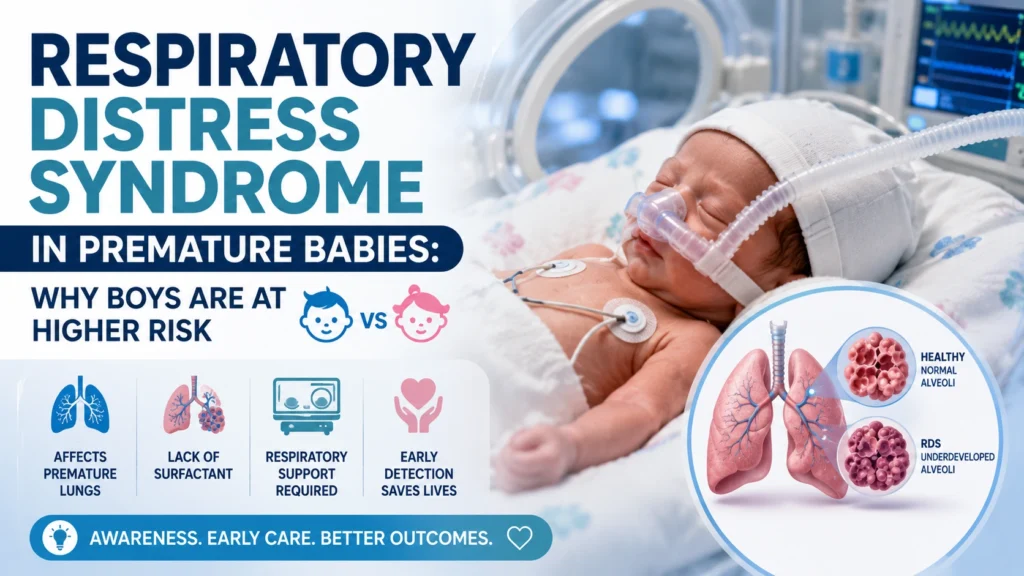
What Respiratory Distress Syndrome Is
RDS, also called neonatal respiratory distress syndrome or hyaline membrane disease, happens when a baby’s lungs haven’t produced enough surfactant a substance that keeps the tiny air sacs in the lungs (alveoli) open between breaths. Without adequate surfactant, the alveoli collapse after each exhale, forcing the baby to work much harder to breathe. Signs include rapid breathing, grunting, flaring nostrils, and a bluish tinge to the skin from low oxygen.
It is primarily a disease of prematurity. Surfactant production ramps up late in pregnancy, so the earlier a baby is born, the less surfactant is on board and the higher the risk. Most cases occur in babies born before 34 weeks, though it can occasionally affect babies born closer to term.
Why Male Sex Raises the Risk
The size of the sex difference is large and consistent. A widely cited study found RDS in 29.1% of premature male infants compared with 8.6% of females at the same gestational ages roughly a 3.4-fold difference. A more recent meta-analysis pooling data from over 500,000 preterm infants found a sex ratio of 1.56 to 1.84 favoring higher risk in males, and the gap has not narrowed even with modern treatments like antenatal steroids and surfactant therapy.
The mechanism is reasonably well understood. Male fetuses reach surfactant maturity on average about 1.4 weeks later than female fetuses at the same gestational age. Research points to androgens (male sex hormones present even in fetal life) as slowing the maturation of the specific lung cells called Type II alveolar cells that produce surfactant. Female fetuses, by contrast, benefit from relatively higher estrogen levels, which appear to encourage earlier surfactant production. This is a hormonal and developmental difference, not a difference in overall health or resilience male infants who develop RDS respond to treatment just as well as female infants; they are simply more likely to need it in the first place.
This “male disadvantage” in prematurity isn’t limited to RDS it also shows up in bronchopulmonary dysplasia (a chronic lung condition sometimes following RDS) and in overall respiratory morbidity for premature infants generally. Researchers describe it as one of the most consistent findings in neonatal medicine, documented for more than a century.
Other Risk Factors
Sex is one factor among several. Others include:
- Gestational age – the single biggest factor; risk rises sharply the earlier a baby is born
- Cesarean delivery without labor – labor itself triggers hormonal changes that help clear fetal lung fluid and support surfactant release
- Maternal diabetes – associated with delayed lung maturation independent of gestational age
- Multiple births (twins, triplets) – often linked to earlier delivery
Prevention: Antenatal Corticosteroids
When preterm birth is anticipated, doctors commonly give the mother a course of corticosteroids (such as betamethasone) 24 to 48 hours before delivery, if timing allows. This accelerates fetal lung maturation and surfactant production, substantially reducing RDS risk and severity in both sexes. Notably, some research has found corticosteroids to be even more effective in reducing RDS risk in female infants than male infants meaning the underlying sex gap can actually widen after treatment, even though absolute risk drops for everyone. This is a genuine, unresolved question in neonatal research rather than a settled explanation.
Treatment
Babies with RDS are cared for in a neonatal intensive care unit (NICU). Treatment typically includes:
- Surfactant replacement therapy – synthetic or animal-derived surfactant given directly into the baby’s airway, often producing rapid improvement
- Respiratory support – ranging from supplemental oxygen and CPAP (continuous positive airway pressure) for milder cases to mechanical ventilation for more severe cases
- Supportive care – temperature regulation, nutrition, and monitoring while the lungs mature
Outcomes have improved enormously over the past several decades because of antenatal steroids and surfactant therapy. Most babies who survive the initial illness go on to have normally functioning lungs, though the most extremely premature infants can be at higher risk of longer-term respiratory issues such as bronchopulmonary dysplasia.
Related Newborn Heart and Lung Conditions
RDS is a lung problem, but premature and newborn infants are sometimes screened for structural heart conditions at the same time, since the two can share overlapping symptoms such as rapid breathing and a bluish tinge to the skin. Two conditions worth knowing the difference between are cyanotic congenital heart disease, where oxygen-poor blood reaches the body directly, and acyanotic congenital heart disease, where the defect doesn’t cause that direct mixing. A pediatric team can tell these apart from RDS with an echocardiogram and oxygen-saturation testing.
Respiratory Distress Syndrome by M. Connelly, A. Erickson, L. Rubin | OPENPediatrics
Frequently Asked Questions
Male fetuses reach lung surfactant maturity later than female fetuses at the same gestational age, a difference linked to the effect of androgens (male sex hormones) on the lung cells that produce surfactant. Studies consistently show premature boys are 1.5 to 3 times more likely to develop RDS than premature girls born at the same point in pregnancy.
No. This is a specific developmental timing difference in one organ system, not a general difference in resilience or health. A male infant who develops RDS responds to surfactant therapy and respiratory support just as well as a female infant with the same condition. The difference is in how often the condition occurs, not in outcomes once it’s treated.
When preterm birth is anticipated, a course of antenatal corticosteroids given to the mother 24 to 48 hours before delivery substantially reduces the risk and severity of RDS for the baby, regardless of sex. It’s one of the most effective interventions in modern obstetric care for this purpose.
For most babies, outlook is good surfactant therapy and modern NICU care mean the large majority go on to have normal lung function. The most extremely premature infants, and those who develop a related chronic condition called bronchopulmonary dysplasia, face a higher chance of ongoing respiratory issues and warrant longer-term follow-up with a pediatrician.
Sources
- Townsel CD, et al. Gender Differences in Respiratory Morbidity and Mortality of Preterm Neonates. Frontiers in Pediatrics, 2017.
- Incidence of respiratory distress syndrome following antenatal betamethasone. PubMed.
- Fang K, et al. The association between sex and neonatal respiratory distress syndrome. BMC Pediatrics, 2024.
- Pattnaik P, et al. Neonatal Respiratory Distress Syndrome. StatPearls, NCBI Bookshelf, updated February 2026.
- Eunice Kennedy Shriver National Institute of Child Health and Human Development
This article is for general information only and is not a substitute for a clinical assessment. If your baby shows signs of breathing difficulty, seek immediate medical attention. It has not been reviewed by a named clinician see our sourcing policy. Last updated: August 2026.

