
Calisthenics is resistance training using your own body weight — think squats, push-ups, lunges, dips, jumping jacks, and handstands — rather than external weights like dumbbells or barbells. It builds strength, flexibility, agility, balance, coordination, and cardiovascular conditioning together. The core goal is developing control over moving your own body through space.
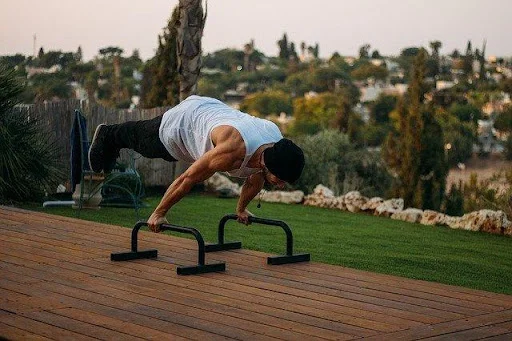
Despite feeling like a modern fitness trend, calisthenics is genuinely ancient — the name derives from the Greek words kallos (beauty) and sthénos (strength).
5 Benefits of Calisthenics
1. No Equipment Needed
You can do calisthenics almost anywhere, anytime. It’s one of the few ways to build real strength and muscle without needing weights or a gym membership.
2. Translates to Everyday Movement
Because calisthenics is centered on controlling your own body in space, it functions as functional movement training — the kind that carries over directly into everyday tasks and the physical demands of work or sport.
3. Works the Whole Body
Calisthenics movements generally engage the whole body rather than isolating a single muscle, distributing effort from your feet to your fingertips in many exercises.
4. Joint-Friendly When Progressed Sensibly
Weight training done with too much load, too frequently, or with imbalanced programming can put real strain on tendons, ligaments and connective tissue. Calisthenics tends to build strength and size more in proportion to your existing musculature, using natural, simple movement patterns — though this doesn’t mean it’s risk-free, and progressing too fast on advanced calisthenics skills (like planches or one-arm work) carries its own injury risk.
5. Builds Flexibility, Balance and More
Calisthenics also develops coordination, flexibility, balance, and muscular endurance alongside strength.
Can You Build a Good Physique With Calisthenics?
Yes — you can build real muscle with bodyweight training. But a few things are worth knowing before you decide which approach fits your goal.
Which Physique Are You Aiming For?
If you want a bodybuilder-style physique, external weight training is genuinely the more effective route — that specific look is built on progressive heavy loading that’s much harder to replicate with bodyweight alone.
If you’re after a lean, athletic, gymnast-style physique, bodyweight training gets you there — but it still requires consistent training and appropriate nutrition, the same as any approach.
Weight training (dumbbells, kettlebells, sandbags all count) does tend to be somewhat more efficient for pure hypertrophy, since it’s easier to add small, precise increments of resistance over time than it is with bodyweight alone. Many athletes combine both approaches for this reason — but you don’t have to. You can build substantial muscle mass with bodyweight training alone; it typically takes longer to add resistance progressively (through harder variations, added reps, or a weighted vest), but the strength and muscle gained are entirely real.
Benefits of Weight Training
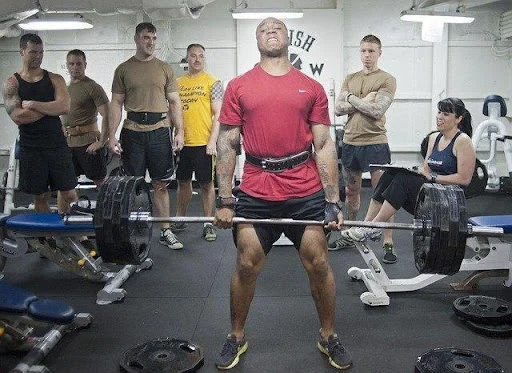
Weight training supports weight management, helps prevent bone loss, and can improve balance and energy levels. Having more muscle mass is also associated with better insulin sensitivity and glucose tolerance.
4 Benefits of Weightlifting
1. Improves Body Composition
Weight training can reduce body fat and build muscle mass. Combined with cardiovascular training and good nutrition, it’s an effective route to improving overall body composition.
2. Supports Metabolism
Muscle tissue burns more calories at rest than fat tissue does, so building muscle modestly raises resting metabolic rate over time — commonly cited estimates are in the range of roughly 6 calories per pound of muscle per day, not a dramatic number on its own, but it adds up as total muscle mass increases and compounds with the calories burned during the training itself.
3. Helps Prevent Injury
Stronger, better-conditioned muscles help your body handle unexpected physical demands — catching yourself from a slip, or lifting something heavier than usual — with less risk of injury.
4. Supports Bone Density
Weight-bearing resistance training stimulates bone density, which can help reduce the risk of fractures and osteoporosis (a condition marked by low bone mass and weakened bone structure). Combining adequate nutrition with resistance training may help offset some age-related bone loss.
Can You Isolate Specific Muscle Groups?
Isolation is generally easier with weight training — machines and free-weight isolation exercises can target one primary muscle group with most of the resistance, making it more straightforward to build size in a specific area. True isolation is harder (though not impossible) to achieve with bodyweight movements, which tend to recruit multiple muscle groups together.
Which Is Better for Fat Loss?
Calisthenics tends to burn more calories during the workout itself, since it typically involves continuous, whole-body movement demanding more energy in the moment. Weight training, meanwhile, tends to support fat loss more through its effect on resting metabolism afterward — muscle built through resistance training modestly raises your baseline calorie burn even at rest.
In practice, this means neither is clearly “better” for fat loss in isolation — they contribute through different mechanisms, and combining both tends to outperform either alone. Calisthenics done in a high-intensity interval or circuit format can further increase calories burned during the session.
Bodyweight vs Weights for Fat Loss
An hour of bodyweight exercise can burn roughly 200 to 400 calories or more depending on intensity, while a more intense session (either style) will burn more. But there’s a limit to how much muscle you can add at once, so the resting-metabolism benefit from added muscle mass builds gradually rather than immediately. Combining weight training with bodyweight work — rather than choosing one exclusively — is a reasonable approach for fat loss goals, alongside attention to overall diet, which remains the larger lever for most people.
Frequently Asked Questions
Can you build muscle with only calisthenics?
Yes. Bodyweight training can build substantial muscle, though progressing resistance (through harder variations, added reps, or a weighted vest) tends to happen more gradually than with external weights.
Is bodyweight training better than the gym?
Neither is categorically better – bodyweight training is accessible, joint-friendly when progressed sensibly, and builds real strength, but weight training makes it easier to progressively overload specific muscle groups, particularly the lower body. Many people benefit from combining both.
Are advanced calisthenics athletes as strong as bodybuilders?
They’re strong in different ways rather than directly comparable – calisthenics athletes typically excel at relative strength and body control (like planches or muscle-ups), while bodybuilders typically train for maximal muscle size, which involves different training emphases.
Is calisthenics the same as bodyweight exercise?
Broadly yes – calisthenics is a specific tradition and style of bodyweight training that emphasizes compound, whole-body movements and skill progressions.
This article is for general information and is not a substitute for medical advice.

