

Quick answer: yes. Mirtazapine is one of the antidepressants most consistently associated with weight gain, and increased appetite is a recognised effect rather than an unusual one. But the size of the average gain is smaller than its reputation suggests and that gap between the average and the reputation is the most useful thing to understand about this drug. Do not stop or change mirtazapine because of weight. Speak to your prescriber first.
The Contradiction Worth Understanding
Mirtazapine appears at opposite ends of two different rankings, and most articles quote only one of them.
A large network meta-analysis published in The Lancet in 2025 compared antidepressants against placebo for weight change. Mirtazapine did show a real increase but at +0.87 kg relative to placebo, it sat below maprotiline (+1.82 kg), amitriptyline (+1.60 kg), milnacipran (+1.16 kg), mianserin (+1.15 kg) and fluvoxamine (+0.96 kg). On mean weight change, mirtazapine is not the worst offender.
Yet a UK primary-care cohort that followed patients for ten years found mirtazapine had the highest risk of clinically significant weight gain of twelve antidepressants studied, with an adjusted rate ratio of 1.50.
Both findings are correct, because they answer different questions. Mean weight change and risk of substantial weight gain are not the same measurement. Mirtazapine’s effect appears to be concentrated rather than spread evenly: a subset of people gain a lot, many gain little or nothing, and averaging the two groups produces a modest-looking number that describes almost nobody’s actual experience.
This is why the drug’s reputation and the trial averages seem to disagree. If you are in the group that responds strongly, the average is irrelevant to you.
What the Numbers Actually Show
| Finding | Source and context |
|---|---|
| +0.87 kg vs placebo | 2025 network meta-analysis of randomised trials. Strong evidence of gain, but modest in size and largely from short-term trials |
| +1.74 kg in acute treatment (4–12 weeks); +2.59 kg longer term (4 months or more) | Meta-analysis of 116 studies, which ranked amitriptyline, mirtazapine and paroxetine as the highest-risk antidepressants for weight gain |
| Rate ratio 1.50 for clinically significant gain | Ten-year UK primary-care cohort; the highest of twelve antidepressants examined |
| Roughly 22% gained more than 7% of body weight by 9 months | Reported in a review of antidepressants and weight; figures across studies vary widely |
Two honest caveats. Reported incidence figures for substantial gain range widely between studies, so treat any single percentage with caution. And a 2025 systematic review of mirtazapine’s adverse effects concluded that while the drug clearly increases the risks of weight gain, increased appetite, somnolence, dry mouth and dizziness, its long-term effects remain poorly established most trial data is short.
Why It Happens
Unlike most antidepressants, where the mechanism behind weight change is unclear, mirtazapine’s is reasonably well understood and it explains both the appetite effect and the sedation in one go.
- Histamine H1 blockade. Mirtazapine binds strongly to H1 receptors. Blocking them causes drowsiness, which is why the drug is prescribed off-label for sleep and the same blockade stimulates appetite. The sedation and the hunger are two faces of one action.
- Serotonin 5-HT2C blockade. This receptor normally restrains appetite. Blocking it removes a brake.
- Reduced daytime activity. If sedation carries over into the day, energy expenditure falls without any change in eating.
- Recovery of appetite. Depression suppresses appetite in many people. Some of the weight that returns as symptoms improve is recovery, not a drug effect a distinction covered in our guide to the causes of weight gain.
The appetite effect tends to appear early, often within the first weeks, which is unusual with most antidepressants weight changes emerge gradually.
Sometimes the Weight Gain Is the Point
Worth stating plainly, because it changes how the side effect should be read: mirtazapine is sometimes chosen because it stimulates appetite. For someone who is underweight, has lost weight through illness, or is not eating because of depression, an antidepressant that restores appetite and improves sleep is doing two useful things at once.
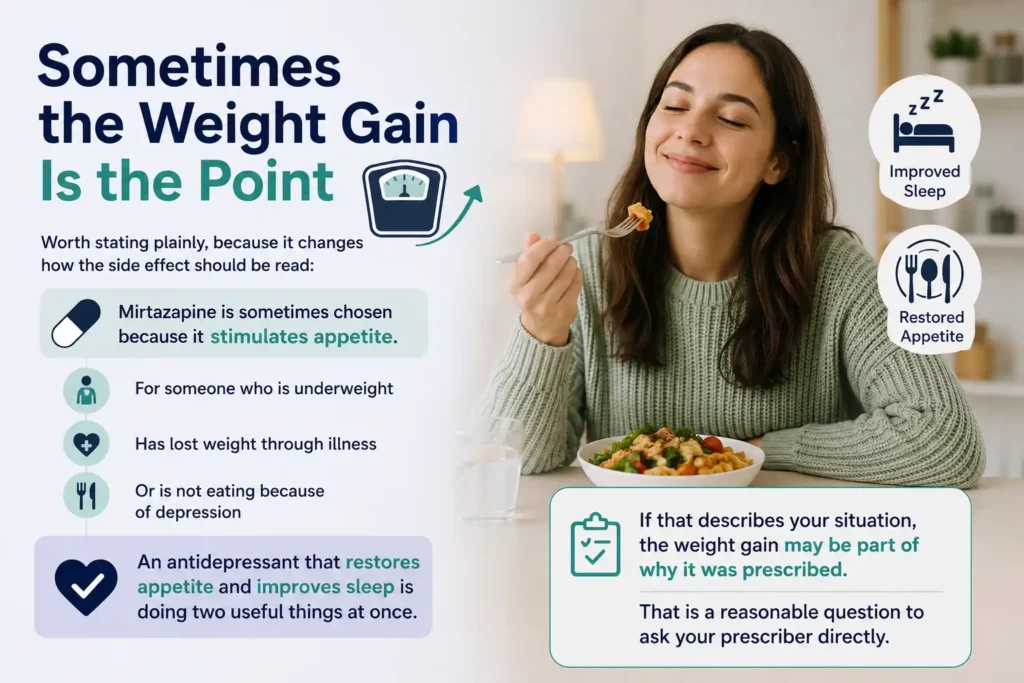
If that describes your situation, the weight gain may be part of why it was prescribed. That is a reasonable question to ask your prescriber directly.
How It Compares
The 2025 network meta-analysis found evidence of weight loss relative to placebo with agomelatine (-2.44 kg), moclobemide, fluoxetine, bupropion, sertraline, venlafaxine, duloxetine, citalopram and desvenlafaxine. Bupropion and fluoxetine have the most consistent evidence of a favourable weight profile across reviews.
One nuance that trips people up: paroxetine appears with slight weight loss in short-term randomised trials, yet is repeatedly identified alongside mirtazapine and amitriptyline as a high-risk drug for weight gain over longer periods. Short-term trial data and long-term outcomes genuinely diverge for some of these medicines, and quoting only one gives a misleading picture.
Related: does Zoloft cause weight gain? and does trazodone cause weight gain?
Two Things Worth Raising With Your Prescriber
Dose. Independent drug-review guidance notes that doses above 30 mg daily deliver fewer additional benefits while markedly increasing harms. If you are above that, it is a legitimate thing to ask about.
Combination. The same guidance notes that adding mirtazapine to an SSRI or SNRI has not been shown to improve effectiveness, while it does increase side effects. If mirtazapine was added to an existing antidepressant and weight gain has followed, that is worth reviewing.
Neither is a reason to change anything yourself. Both are reasonable questions to bring to an appointment.
If Weight Is Changing on Mirtazapine
- Report it, do not stop it. Stopping abruptly can cause discontinuation symptoms and a return of depression or insomnia. Any change is made with your prescriber, usually by tapering.
- Raise it early. Because the appetite effect appears in the first weeks, the first review appointment is the natural time not a year in.
- Mention daytime drowsiness separately. If sedation is limiting your activity, dose timing is sometimes adjustable, and that is a different problem from appetite.
- Do not start restrictive dieting while adjusting to it. Under-eating worsens mood, sleep and energy, and it makes it impossible to tell what is causing what.
- Alternatives exist within the same job. If mirtazapine was chosen partly for sleep, there may be other routes to that. Weight is a legitimate factor to weigh alongside how well the medication is treating your symptoms.
Untreated depression carries substantial risks of its own. The goal is finding a treatment that works and that you can live with, not avoiding treatment.
What Is Mirtazapine (Remeron)? Dosing, Side Effects, And More! | Dr. Aly
Frequently Asked Questions
Averages are modest: a 2025 network meta-analysis found +0.87 kg relative to placebo, and an earlier meta-analysis of 116 studies found +1.74 kg over 4 to 12 weeks and +2.59 kg beyond four months. But the average is misleading, because the effect appears concentrated in a subset of people rather than spread evenly. Some gain substantially and many gain little.
Mainly through blockade of histamine H1 receptors, which also causes the drowsiness the drug is known for, and through blockade of serotonin 5-HT2C receptors, which normally help restrain appetite. The sedation and the hunger come from the same pharmacology.
The appetite effect often appears within the first weeks, which is unusual with most antidepressants weight changes develop gradually. That makes the first review appointment the natural time to raise it rather than waiting.
A 2025 network meta-analysis found evidence of weight loss relative to placebo with agomelatine, moclobemide, fluoxetine, bupropion, sertraline, venlafaxine, duloxetine, citalopram and desvenlafaxine. Bupropion and fluoxetine have the most consistent favourable profiles across reviews. This is context for a conversation with your prescriber, not a basis for switching on your own.
This is commonly assumed and is not well established the appetite effect is prominent at lower doses too, which is part of why the drug is used off-label for sleep. What independent drug-review guidance does note is that doses above 30 mg daily add little benefit while increasing harms, which makes dose a reasonable thing to ask your prescriber about.
No, not on your own. Stopping abruptly can cause discontinuation symptoms and a return of depression or insomnia. Report the change to your prescriber, who can look at dose, timing or alternatives. Note also that mirtazapine is sometimes prescribed specifically because it stimulates appetite, so it is worth asking whether that was part of the reason in your case.
Sources
- The effects of antidepressants on cardiometabolic and other physiological parameters: a systematic review and network meta-analysis. The Lancet, 2025.
- Serretti A, Mandelli L. Antidepressants and body weight: a comprehensive review and meta-analysis. Journal of Clinical Psychiatry, 2010.
- Antidepressant utilisation and incidence of weight gain during 10 years’ follow-up: population based cohort study. BMJ, 2018.
- Kamp CB, Petersen JJ, et al. The risks of adverse events with mirtazapine for adults with major depressive disorder: a systematic review with meta-analysis. BMC Psychiatry, 2025.
- Therapeutics Letter 129 – Mirtazapine: update on efficacy, safety and dose response.
Related reading: Weight Gain Guide: causes, medications and when to see a doctor | Does Zoloft cause weight gain? | Does trazodone cause weight gain?
Written and fact-checked by the HealthCoachJP editorial team. No clinician has reviewed this article. It is general information about a prescription medicine, not medical advice and not a dosing guide. Follow the instructions you were given and read the patient information leaflet supplied with your medication. Never start, stop or change a prescribed antidepressant on your own. If you are having thoughts of harming yourself, contact your prescriber or emergency services now; in the US, call or text 988.
Last updated: August 2026. See our sourcing policy.