

Quick answer: some do, some do not, and which one you are on matters far more than the dose. Older beta blockers such as atenolol, metoprolol and propranolol are associated with modest weight gain on the order of one to two kilograms, mostly in the first few months. Newer vasodilating beta blockers such as carvedilol and nebivolol are close to weight-neutral.
Two things before the detail. Never stop a beta blocker abruptly sudden withdrawal can cause rebound rapid heart rate, chest pain and, in people with heart disease, serious cardiac events. And if you have heart failure, read the red-flag section below before anything else, because rapid weight gain means something different for you.
⚠️ If You Have Heart Failure, Rapid Weight Gain Is a Warning Sign
This is the most important thing on this page, and it inverts everything else on it.
Beta blockers are a cornerstone treatment for heart failure. In someone with heart failure, a sudden increase in weight is a recognized sign of fluid building up because the heart failure is worsening not a metabolic side effect of the tablet. Drug-related weight gain is gradual, over months. Fluid from decompensating heart failure arrives over days.
Contact your care team the same day if you experience:
- A rise of roughly 2 to 3 kg (4 to 5 lb) within a few days, or 1 kg overnight
- New or worsening swelling in the ankles, legs or abdomen
- Increasing breathlessness, especially lying flat, or waking at night short of breath
- Needing more pillows than usual to sleep
This is why heart failure patients are asked to weigh themselves daily. The scale is being used as a fluid monitor, not a fat monitor.
The Mechanism Is Not Appetite And That Changes Everything
Every other medication class covered on this site works on weight mainly through hunger. Mirtazapine, antipsychotics and corticosteroids all increase appetite. Beta blockers do not. They reduce the amount of energy you burn.
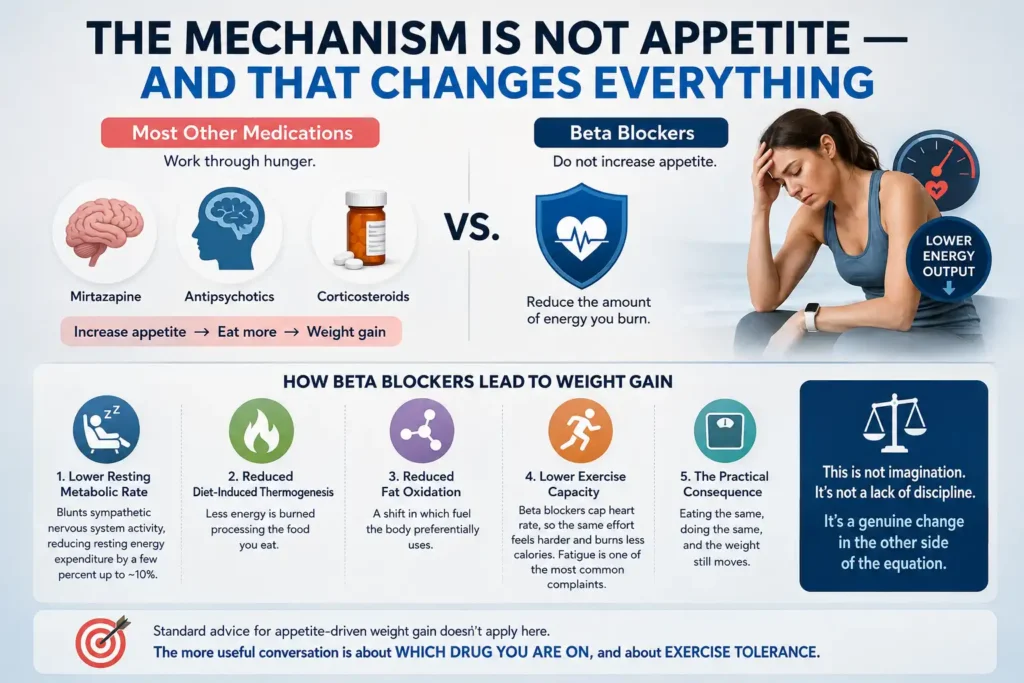
- Lower resting metabolic rate. Blocking beta receptors blunts sympathetic nervous system activity, which is one of the drivers of resting energy expenditure. Reported reductions are in the region of a few per cent up to around 10%.
- Reduced diet-induced thermogenesis less energy burned processing food.
- Reduced fat oxidation a shift in which fuel the body preferentially uses.
- Lower exercise capacity. Beta blockers cap heart rate, so the same effort feels harder and the same workout burns less. Fatigue is one of the most common complaints on these drugs.
The practical consequence is the thing people describe and are rarely believed about: eating the same, doing the same, and the weight still moves. That is not imagination and it is not a failure of discipline. It is a genuine change in the other side of the equation.
It also means the standard advice for appetite-driven weight gain does not transfer. This is a class where the more useful conversation is about which drug you are on, and about exercise tolerance.
Which Beta Blockers, and How Much
| Group | Examples | Weight effect |
|---|---|---|
| Older, non-vasodilating | Atenolol, metoprolol, propranolol, bisoprolol, timolol | Associated with weight gain. Trials lasting six months or more report a median of around 1.2 kg |
| Newer, vasodilating | Carvedilol, nebivolol, labetalol | Close to weight-neutral; minimal effect on glucose and lipid measures |
The clearest evidence comes from a head-to-head comparison rather than separate studies. The GEMINI trial randomised 1,106 patients with type 2 diabetes and hypertension and measured weight at five months. Metoprolol tartrate produced a significant mean gain of 1.19 kg. Carvedilol produced 0.17 kg, which was not statistically significant.
The detail that matters most sits underneath that headline: the gap widened with body size. Among participants with a BMI above 30, the difference between the two drugs was about 0.9 kg; above BMI 40, it was about 1.8 kg. In other words, the people most affected by the drug choice are the people most likely to be prescribed a beta blocker for blood pressure in the first place.
For propranolol, longer-term data reports around 2.3 kg at one year against 1.2 kg on placebo, with the difference persisting for several years.
The Effect Is Front-Loaded, and It May Be Less About Gaining Than About Not Losing
Two consistent findings that most coverage of this topic omits.
It happens early, then stops. Weight gain on traditional beta blockers occurs predominantly in the first few months to the first year, with no significant further gain afterwards compared with controls. If you have been on one for years and your weight is climbing now, the beta blocker is probably not the explanation, and something else is worth looking at our guide to the causes of weight gain covers the alternatives.
The bigger effect may be blunted weight loss. In studies of people following a controlled diet and exercise programme, those on older beta blockers lost less weight than those not on one or on a newer agent, remaining meaningfully heavier than untreated participants. If you are actively trying to lose weight and the results are worse than you expected, an older beta blocker is a plausible part of the explanation and one worth naming rather than blaming yourself for.
What Is Worth Discussing With Your Doctor

- Why you are on it. A beta blocker prescribed for heart failure, a previous heart attack or an arrhythmia is doing a job with strong evidence behind it. One prescribed for uncomplicated high blood pressure is a different case guidelines have moved away from beta blockers as first-line for that indication, partly because of these metabolic effects.
- Whether a different beta blocker fits. Where a beta blocker is genuinely needed, carvedilol and nebivolol are the more weight-neutral options. Suitability depends on your condition carvedilol and metoprolol are not interchangeable in every situation.
- Whether a different class fits. For blood pressure alone, ACE inhibitors, ARBs and calcium channel blockers are generally weight-neutral alternatives.
- Exercise, specifically. Because these drugs cap heart rate, heart-rate-based training targets can be misleading on them. How to judge exertion is a practical question worth asking.
- Recent medication changes. Switching from a diuretic to a beta blocker can add a few pounds of fluid the diuretic had been removing. That is not fat.
Can beta blockers cause WEIGHT GAIN?
Frequently Asked Questions
The older non-vasodilating ones atenolol, metoprolol, propranolol, bisoprolol and timolol are the group associated with weight gain, typically around 1.2 kg in trials lasting six months or more. Carvedilol, nebivolol and labetalol are close to weight-neutral.
Yes, and this was tested directly. The GEMINI trial randomised 1,106 patients with type 2 diabetes and hypertension: metoprolol produced a significant mean gain of 1.19 kg at five months while carvedilol produced 0.17 kg, which was not significant. The difference between the two drugs widened in participants with higher BMI.
Because they work on the other side of the equation. Beta blockers reduce resting metabolic rate, reduce the energy burned processing food, shift fat oxidation, and cap heart rate so exercise becomes harder and burns less. This is why people describe eating and doing the same while the weight still moves.
Probably not, and it needs same-day attention. In heart failure, a rapid rise around 2 to 3 kg over a few days, or 1 kg overnight is a recognised sign of fluid building up as heart failure worsens, particularly alongside new swelling or increasing breathlessness. Drug-related weight gain is gradual over months, not sudden. Contact your care team.
No. Weight gain on traditional beta blockers occurs predominantly in the first few months to the first year and then levels off, with no significant further gain compared with controls. If your weight has started climbing after years on the same beta blocker, something else is more likely to be responsible.
Not on your own, and this one is genuinely dangerous. Stopping a beta blocker abruptly can cause rebound rapid heart rate and chest pain, and in people with heart disease it has been linked to serious cardiac events. Raise it with your doctor, who can review whether a different beta blocker or a different class of medication would suit you.
Sources
- Messerli FH, Bell DS, Fonseca V, et al. Body weight changes with beta-blocker use: results from GEMINI. American Journal of Medicine, 2007.
- Gammone MA, D’Orazio N. Effect of third-generation beta blockers on weight loss in a population of overweight-obese subjects in a controlled dietary regimen. Journal of Nutrition and Metabolism, 2021.
- Mayo Clinic – Beta blockers: do they cause weight gain?
- American Heart Association – Warning signs of heart failure
- MedlinePlus – Metoprolol
Related reading: Weight Gain Guide: causes, medications and when to see a doctor | Do gabapentin and pregabalin cause weight gain? | Heart Disease Guide
Written and fact-checked by the HealthCoachJP editorial team. No clinician has reviewed this article. It is general information about prescription medicines, not medical advice and not a dosing guide. Never stop or reduce a beta blocker without your doctor’s instruction – abrupt withdrawal can be dangerous. If you have heart failure and your weight rises rapidly, contact your care team the same day.
Last updated: August 2026. See our sourcing policy.